


Tom Lee’s bullish stance has historically influenced investor sentiment, especially during major market turning points. This time, his optimism is supported by strong institutional accumulation, increasing Ethereum staking activity, improving regulatory discussions, and expanding real-world blockchain adoption. The recent acquisition by Bitmine strengthens the narrative that large corporations and institutional investors are preparing for the next phase of crypto expansion.
As the crypto market evolves, Ethereum continues to stand at the center of innovation. From decentralized applications to tokenization and smart contracts, Ethereum’s ecosystem keeps attracting investors looking for long-term growth opportunities. The latest treasury purchase demonstrates how institutional demand is becoming a powerful driver of market momentum.
Tom Lee Declares the Beginning of a Crypto Spring
According to Tom Lee, the cryptocurrency market is entering what he calls a “crypto spring.” This phrase refers to a period when digital assets recover from bearish sentiment and begin a renewed growth cycle supported by stronger fundamentals and institutional confidence.
Lee explained that investor sentiment remains relatively cautious despite improving market conditions. Historically, some of the strongest crypto rallies begin when skepticism is still widespread. He believes current market conditions resemble the early stages of previous bullish cycles that later produced explosive growth in Bitcoin and Ethereum prices.
The concept of a crypto spring is particularly important because it highlights the transition from fear-driven trading toward renewed accumulation. During crypto winters, investors often avoid risk, trading volumes decline, and prices remain under pressure. A crypto spring represents the opposite environment, where confidence slowly returns and institutional money starts flowing back into the market.
Tom Lee’s comments gained even more credibility because they coincided with Bitmine’s enormous Ethereum acquisition. Large treasury purchases typically signal long-term confidence rather than short-term speculation. Institutional investors rarely deploy hundreds of millions of dollars without expecting future market appreciation.
Lee also emphasized that blockchain adoption continues expanding globally. Governments, financial institutions, and technology companies are increasingly exploring tokenized assets, decentralized systems, and digital payment networks. Ethereum remains central to many of these developments because of its smart contract capabilities and dominant decentralized finance ecosystem.
Why Bitmine’s $238 Million Ether Purchase Matters
Bitmine’s purchase of 101,745 ETH worth around $238 million immediately became one of the most significant institutional Ethereum acquisitions in recent months. The transaction increased the company’s already massive Ethereum treasury holdings and reinforced its position as one of the largest institutional holders of Ether.
Institutional treasury strategies are becoming increasingly important in the crypto market because they reduce circulating supply and increase long-term holding behavior. When companies accumulate large amounts of Ether, they often stake those assets rather than actively trade them. This reduces selling pressure while strengthening network security.
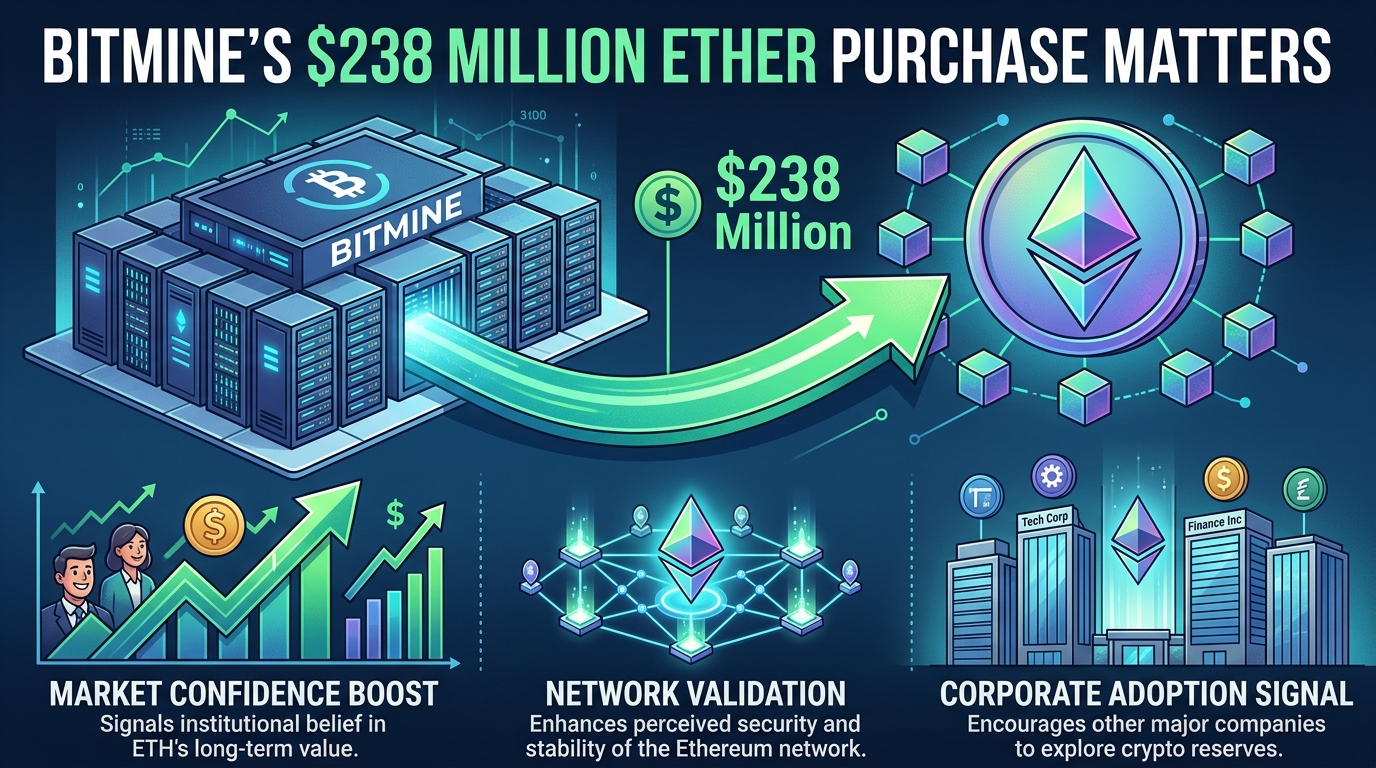
Bitmine reportedly holds millions of ETH and continues expanding its staking operations. Staking allows investors to lock Ethereum into the network in exchange for rewards, creating recurring revenue opportunities while supporting Ethereum’s proof-of-stake infrastructure.
The size of the purchase also matters psychologically. Large acquisitions create confidence among retail traders, hedge funds, and institutional investors who view treasury accumulation as a sign of strong long-term conviction. When companies commit billions to Ethereum exposure, the broader market often interprets it as validation of Ethereum’s future utility and value.
This treasury strategy mirrors earlier institutional Bitcoin accumulation trends that helped fuel previous crypto bull runs. Companies adding crypto assets to their balance sheets can create a supply-demand imbalance, especially when market demand continues rising.
Ethereum Remains the Core of Institutional Crypto Adoption
Ethereum continues attracting institutional interest because it offers much more than a digital currency. Unlike Bitcoin, which primarily functions as a store of value, Ethereum powers decentralized applications, smart contracts, NFT ecosystems, tokenization platforms, and decentralized finance services.
Many institutional investors see Ethereum as the backbone of future blockchain infrastructure. Financial firms are increasingly exploring tokenized securities, digital identity systems, and blockchain settlement layers built on Ethereum-compatible networks.
Ethereum’s transition to proof-of-stake also improved its attractiveness to institutional investors focused on sustainability and energy efficiency. The network now consumes significantly less energy compared to traditional proof-of-work systems, addressing one of the major criticisms previously directed at cryptocurrencies.
Another important factor driving institutional adoption is staking yield. Ethereum holders can generate passive returns through staking, making ETH resemble a yield-bearing digital asset rather than purely a speculative investment. This feature appeals strongly to treasury managers and institutional investors seeking long-term returns.
Tom Lee specifically highlighted Ethereum’s growing importance in tokenization and artificial intelligence infrastructure. As AI systems increasingly require decentralized verification and payment networks, Ethereum could become a major settlement layer for future digital economies.
Institutional Investors Are Reshaping the Crypto Market
The cryptocurrency industry has evolved significantly from its early retail-driven trading environment. Today, institutional investors play a central role in market direction, liquidity, and long-term adoption. Hedge funds, public companies, investment firms, and crypto treasury corporations are accumulating digital assets at unprecedented levels. This institutional participation brings greater legitimacy to the crypto market and reduces concerns about long-term sustainability.
Large-scale treasury acquisitions like Bitmine’s Ethereum purchase demonstrate how institutional strategies differ from short-term speculative trading. Institutions often focus on multi-year investment horizons, staking rewards, and infrastructure development rather than quick market gains. Institutional accumulation also influences price dynamics because it reduces available supply on exchanges. When large investors purchase and hold Ethereum for staking or treasury purposes, fewer tokens remain available for trading. This can amplify upward price movements during periods of rising demand.
Additionally, institutional involvement encourages stronger regulatory discussions and infrastructure improvements. Governments and regulators tend to engage more seriously with industries attracting major financial players. This could ultimately help create clearer crypto regulations and more stable investment environments. The growing presence of institutional capital is one reason many analysts believe the crypto market is maturing into a mainstream financial sector rather than remaining a speculative niche industry.
Ethereum Staking Strengthens Long-Term Market Confidence
One of the biggest drivers behind Ethereum’s institutional appeal is staking. Since Ethereum transitioned to proof-of-stake, staking has become central to network security and investor participation. Bitmine reportedly staked millions of ETH as part of its treasury strategy, generating significant annualized revenue through staking rewards. This approach transforms Ethereum from a passive holding into an income-generating asset. Ethereum staking creates several bullish market dynamics. First, staked ETH becomes temporarily locked, reducing circulating supply. Second, staking incentivizes long-term holding behavior because investors earn ongoing rewards. Third, it strengthens network security and decentralization.

Institutional staking participation also demonstrates confidence in Ethereum’s long-term stability. Large investors would likely avoid locking billions of dollars into staking if they expected severe long-term market weakness. Retail investors are increasingly following institutional strategies by participating in staking pools and decentralized staking platforms. This broader participation further strengthens Ethereum’s ecosystem while creating additional demand for ETH ownership. As more Ethereum becomes staked, market analysts expect supply scarcity to increase, potentially supporting higher prices during bullish market cycles.
Regulatory Developments Could Support Crypto Growth
Tom Lee also referenced improving regulatory momentum in the United States as a factor supporting the new crypto spring narrative. Regulatory clarity remains one of the most important issues affecting institutional crypto adoption. For years, uncertainty around digital asset regulations discouraged many institutional investors from entering the market aggressively. However, recent legislative discussions and proposed frameworks suggest governments are becoming more open to integrating crypto into traditional financial systems.
Clearer regulations could encourage additional institutional participation by reducing legal uncertainty and compliance risks. Large financial institutions typically require transparent regulatory frameworks before making substantial investments in emerging asset classes. The crypto industry is increasingly working alongside policymakers to develop regulations that support innovation while protecting investors. This collaboration may help establish long-term market stability and encourage broader adoption of blockchain technologies.
Regulatory progress is particularly important for Ethereum because many decentralized finance applications and tokenization projects rely on Ethereum infrastructure. Improved legal clarity could accelerate enterprise blockchain adoption and attract even larger institutional capital flows.
Ethereum’s Role in the Future Digital Economy
Ethereum’s long-term investment appeal extends beyond price speculation. Many analysts believe Ethereum could become a foundational layer for the future digital economy. The network already powers decentralized finance protocols handling billions of dollars in value. It also supports NFT marketplaces, gaming ecosystems, tokenized real-world assets, and decentralized autonomous organizations.
Tokenization is emerging as one of Ethereum’s most promising growth sectors. Financial institutions increasingly explore converting traditional assets like stocks, bonds, and real estate into blockchain-based tokens. Ethereum’s smart contract infrastructure makes it a leading platform for these innovations. Artificial intelligence integration could further expand Ethereum’s utility. Decentralized networks may become essential for secure AI verification, data management, and automated digital payments. Ethereum’s programmable infrastructure positions it well for these future applications.
As blockchain adoption grows globally, Ethereum’s ecosystem advantages could strengthen further. Developers continue building decentralized applications across industries ranging from finance and healthcare to entertainment and logistics. This broad utility helps explain why institutional investors increasingly view Ethereum as a long-term infrastructure investment rather than simply a speculative cryptocurrency.
Market Sentiment Is Slowly Turning Bullish
Crypto market sentiment has improved noticeably following Bitmine’s Ethereum purchase and Tom Lee’s bullish comments. Although many investors remain cautious, signs of renewed optimism are appearing across the market. Bitcoin and Ethereum prices have shown stronger resilience despite geopolitical tensions and macroeconomic uncertainty. Institutional inflows into crypto-related products continue rising, while blockchain adoption headlines regularly attract mainstream attention.
Historically, major bull markets often begin when sentiment remains mixed. Early accumulation phases typically occur before widespread retail enthusiasm returns. Tom Lee believes current market conditions reflect this early-stage recovery pattern. Social media discussions, trading activity, and institutional announcements increasingly point toward growing confidence in crypto markets. While volatility remains a factor, the broader trend suggests institutional investors are positioning themselves for long-term growth opportunities. Ethereum, in particular, appears well-positioned due to its expanding ecosystem, staking economics, and enterprise adoption potential.
Also Read: Crypto Market Update Bitcoin Price Ends Week Higher
Could Another Major Crypto Bull Run Be Starting?
Many investors now wonder whether the crypto market is preparing for another historic bull run. While no market trend is guaranteed, several factors support the possibility of sustained upward momentum. Institutional accumulation remains one of the strongest bullish indicators. Large treasury purchases like Bitmine’s Ether acquisition suggest major investors anticipate long-term market appreciation.
Ethereum’s supply dynamics also support bullish expectations. Increased staking participation reduces liquid supply while demand from institutions, decentralized finance users, and developers continues expanding. Macroeconomic conditions may also favor alternative assets. Some investors increasingly view cryptocurrencies as hedges against inflation, currency debasement, and financial system uncertainty.
Technological adoption continues accelerating as well. Blockchain technology is no longer limited to crypto enthusiasts. Major corporations, banks, and governments are actively exploring blockchain integration across various industries. Tom Lee’s crypto spring thesis reflects the belief that the market is transitioning from recovery into expansion. If institutional inflows continue increasing, Ethereum and the broader crypto market could experience substantial long-term growth.
Conclusion
Tom Lee’s declaration that a new “crypto spring” has started gained significant attention because it coincided with one of the largest recent institutional Ethereum purchases. Bitmine’s $238 million Ether acquisition highlights growing confidence among institutional investors and reinforces Ethereum’s role as a central pillar of the digital asset ecosystem.
The combination of institutional accumulation, Ethereum staking growth, improving regulatory discussions, and expanding blockchain adoption creates a powerful bullish narrative for the crypto market. While volatility will likely remain part of the industry, long-term fundamentals appear increasingly strong.
