


US spot Bitcoin ETFs returned to the center of crypto market attention after posting about $225 million in net inflows, with BlackRock’s IBIT absorbing enough demand to outweigh redemptions seen in other funds. That split is the story: a category can be net positive even when several products lose assets, as long as the largest liquidity hubs keep attracting fresh allocations. In practice, this kind of flow day reflects how the post-launch ETF market is evolving—less like a single unified “Bitcoin ETF trade,” and more like a competitive landscape where investors pick a preferred vehicle for exposure.
For investors, the phrase “US spot Bitcoin ETFs add $225M” is more than a headline. It’s a window into how capital is choosing to enter Bitcoin through regulated rails. When the category is a net buyer, it typically means the ETF complex is accumulating spot Bitcoin on behalf of shareholders, reinforcing demand even if Bitcoin’s price is chopping sideways or reacting to broader macro events. And when IBIT offsets redemptions, it suggests institutions are not abandoning the thesis—many are simply consolidating exposure in the deepest and most familiar fund.
In this article, we’ll unpack how inflows and redemptions work, why BlackRock’s IBIT frequently leads, what the $225M figure can indicate about institutional positioning, and how readers can interpret these signals without overreacting to one day’s data. Along the way, we’ll naturally include LSI phrases like institutional Bitcoin demand, spot ETF inflows, Bitcoin ETF redemptions, Bitcoin market liquidity, and regulated BTC exposure, while keeping the narrative readable and human.
What “US spot Bitcoin ETFs add $225M” really means
The key term in this headline is net inflows. When US spot Bitcoin ETFs add $225M, it means that, across all listed spot Bitcoin ETF products in the United States, the total dollar value of new money entering the funds exceeded the total dollar value leaving the funds by roughly $225 million over the reporting period. That net figure is the result of creations (new shares being issued) minus redemptions (shares being removed).
This matters because spot Bitcoin ETFs are designed to hold Bitcoin directly (or through carefully controlled custody arrangements), so net inflows often translate into incremental spot demand for BTC. In a simple sense, positive net flows are a sign that the ETF channel is functioning as a net buyer of Bitcoin, while negative net flows imply the opposite.
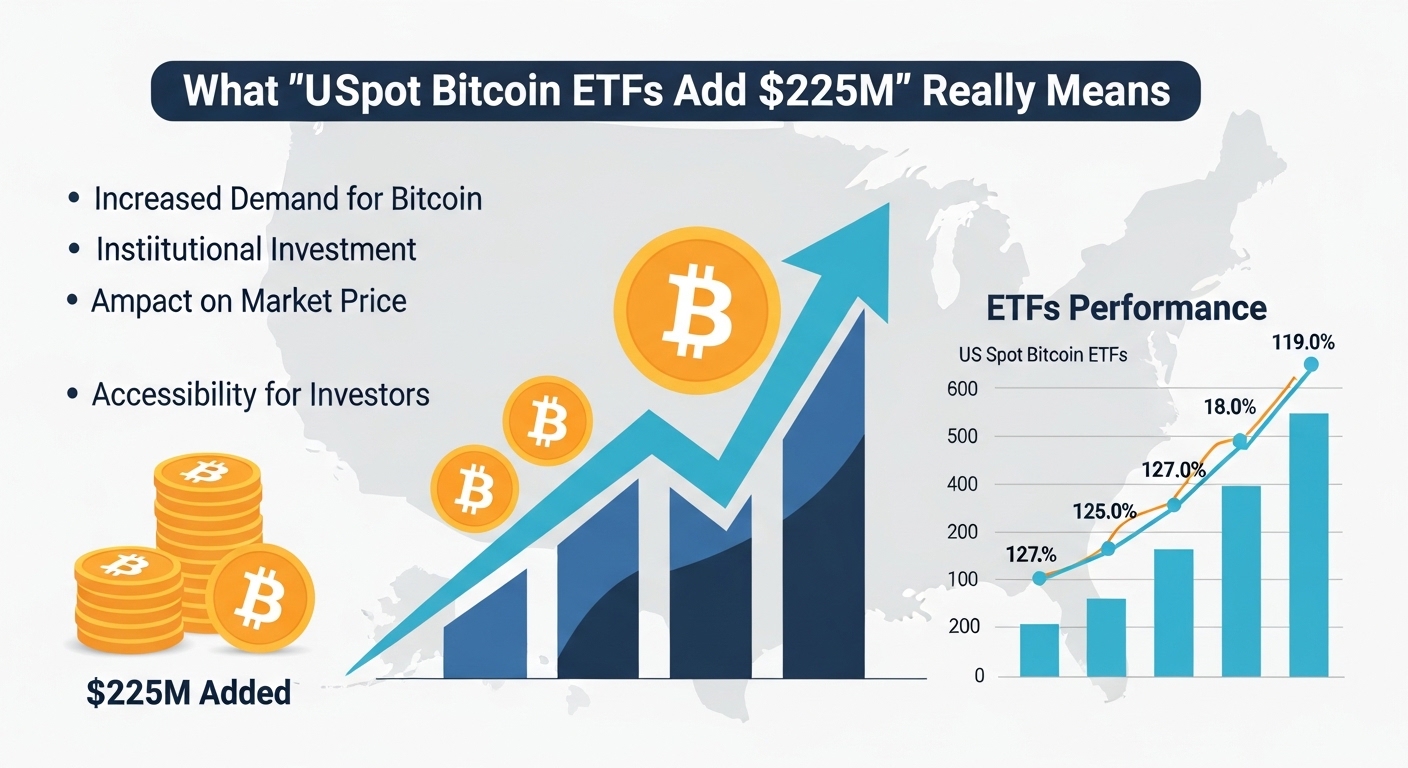
However, not all flow days are “clean” directional signals. A day where US spot Bitcoin ETFs add $225M while several funds experience redemptions is a day of rotation—capital is moving within the category as much as it is entering from outside. That’s why the second half of the title—BlackRock’s IBIT offsets redemptions—is essential to understanding the real message.
How inflows and redemptions work in spot Bitcoin ETFs
The creation and redemption engine, explained clearly
Spot Bitcoin ETFs rely on a mechanism that keeps the ETF’s market price closely aligned with the value of its underlying Bitcoin holdings. When demand rises, specialized market participants create new ETF shares. When demand falls, they redeem shares. This process helps maintain tracking and liquidity.
When inflows happen, new ETF shares are created, and the fund increases its Bitcoin holdings to match. When outflows happen, shares are redeemed, and the fund’s holdings decrease accordingly. That is the mechanical reason why ETF flows can influence spot demand, especially during periods of consistent inflows or intense redemptions.
But even with the same underlying Bitcoin exposure, not every ETF gets the same level of demand. One fund can accumulate while another bleeds, which leads to net outcomes like the one in this headline: the category is positive, yet redemptions still exist.
Why “offsets redemptions” is a meaningful market clue
If a major fund like IBIT attracts strong inflows on a day when peers see outflows, it indicates that buyers are still present and willing to add exposure—but they’re concentrating that exposure in a specific product. In practical terms, this can reflect preferences related to liquidity, trading efficiency, operational comfort, or even how certain platforms route orders.
So, when people read “US spot Bitcoin ETFs add $225M,” the deeper implication is not necessarily “everyone is buying.” It may be “buyers are choosing IBIT as their primary gateway while other funds face selling pressure.” That difference is crucial for interpreting institutional behavior.
Why BlackRock’s IBIT often leads and absorbs category selling
Liquidity tends to attract liquidity
In ETF markets, liquidity can be self-reinforcing. The more a fund trades, the more comfortable large traders are executing size, which draws even more trading and allocations. Over time, the largest funds often become the default choice for institutions who need tight spreads, deep order books, and reliable execution.
That dynamic helps explain why BlackRock’s IBIT frequently shows up as a leader during strong spot ETF inflows. If institutions are deciding where to place a large allocation, they often gravitate toward the vehicle that can handle scale with minimal friction. This doesn’t necessarily mean other funds are flawed—it means that, in a competitive market, liquidity and familiarity tend to win incremental dollars.
Institutional due diligence and “issuer comfort”
Traditional allocators may view the ETF wrapper as the safe bridge into Bitcoin, but they still evaluate issuers through a conventional lens: operational processes, risk controls, custody oversight, and brand reputation. For many committees, an established global asset manager can feel like the least complicated path to approve regulated BTC exposure. That preference can cause IBIT to pull in inflows even when the broader category is mixed. It’s also why you can see the “offset” effect: some investors are selling one fund while buying another, resulting in a net category gain.
Trading behavior: rotation, rebalancing, and platform routing
Not every ETF flow is a long-term conviction move. Some flows reflect tactical decisions: rebalancing after a price swing, adjusting exposure around macro events, or shifting between products due to platform preferences. For example, a desk might reduce exposure in one ETF because of internal rules or liquidity needs, then increase exposure in IBIT because it is the easiest vehicle to trade in size. The net result: redemptions in some funds, but strong creations in BlackRock’s IBIT, and the category ends the day with net inflows.
What the $225M inflow day suggests about institutional Bitcoin demand
Selective demand is still demand
A net positive day is still evidence that some segment of the market wants exposure to Bitcoin through regulated products. Even if several funds record redemptions, the fact that the category ends higher indicates that buyers are willing to step in. The focus shifts from “is there demand?” to “where is demand concentrating?” That concentration can be bullish in a quieter way. It suggests institutions are not necessarily chasing short-term price spikes; they’re choosing efficient instruments. In that sense, the $225M inflow day supports the idea of ongoing institutional Bitcoin demand, even if sentiment is not universally risk-on.
A healthier market can have two-way flows
It’s tempting to view outflows as purely negative, but in mature markets, two-way flow is normal. Investors take profits, manage risk, and rotate exposure. The presence of redemptions alongside inflows can indicate that the ETF market is functioning more like an established asset class rather than a one-directional hype cycle. So, Bitcoin ETF redemptions do not automatically mean “institutions are exiting Bitcoin.” They can mean “some investors are trimming” while others are accumulating. When US spot Bitcoin ETFs add $225M, the net message is that new allocations outweighed reductions.
The signal is stronger when inflows persist
One day’s $225M inflow can be meaningful, but what really shapes market structure is persistence. A series of positive net inflow days can steadily increase ETF-held Bitcoin, potentially tightening available supply over time. That’s when flow data becomes a larger narrative driver. When inflows are consistent, they can influence how Bitcoin reacts to dips. Buyers using spot ETFs may add exposure systematically, which can create a steadier bid in the market. This is one reason many analysts track rolling weekly and monthly flow totals rather than reacting to a single session.
How spot Bitcoin ETF flows can influence Bitcoin price and liquidity
Flows and price do not always move together

It’s important not to oversimplify. Even if spot Bitcoin ETFs add $225M, Bitcoin’s price might not rise immediately. Price is shaped by a combination of factors: spot buying and selling, derivatives positioning, macro risk appetite, and liquidity conditions across global markets. Sometimes inflows lead price, sometimes they follow price, and sometimes they diverge. For instance, inflows can come in after a price drop as institutions “buy the dip,” or they can rise during rallies when momentum attracts new allocations. The same flow number can reflect different motivations depending on the broader environment.
Over time, net inflows can tighten supply
Where flows matter most is in accumulation across longer windows. Spot Bitcoin ETFs that experience sustained net inflows must acquire Bitcoin to back those shares. If that buying is steady, it can reduce the amount of BTC available on exchanges, potentially amplifying price moves when demand increases elsewhere. This is why many traders view ETF flow trends as part of a broader Bitcoin market liquidity framework. They are not the only factor, but they can become a structurally important one in a world where large pools of capital prefer regulated vehicles.
Why other US spot Bitcoin ETFs can see redemptions on the same day
Rebalancing and risk management
Large portfolios often use rules-based rebalancing. If Bitcoin rises and the position becomes overweight relative to targets, managers may trim. If volatility increases, risk models may reduce exposure. Those decisions can trigger redemptions even when a manager still believes in Bitcoin long term. In other words, redemptions are frequently a function of discipline rather than a dramatic change of view. When IBIT offsets redemptions, it implies those disciplined sellers were met by buyers—often buyers choosing the most liquid option.
Fee sensitivity and product selection
The ETF market is competitive. Investors compare fees, spreads, and trading efficiency. Over time, that can cause “winner-takes-more” behavior where the most used products gain share and others lose it. This can produce the appearance of negativity in some funds, even as the category grows. If the overall pie is expanding but more of it is going into one fund, smaller funds may face persistent redemptions. That’s not necessarily a market-wide bearish sign; it can be a market-share story.
Tactical trades and basis positioning
Some ETF activity is not a straightforward long-only bet. Traders may use ETFs as part of relative-value strategies tied to futures premiums or volatility structures. When those strategies unwind, outflows can show up quickly. At the same time, long-only allocators may keep buying, which is how you can get net inflows even with notable redemptions.
Conclusion
The headline “US spot Bitcoin ETFs add $225M as BlackRock’s IBIT offsets redemptions” highlights a defining feature of today’s Bitcoin ETF era: demand is real, but it is often selective. Even when some funds see outflows, the category can still post strong net inflows if a dominant product like IBIT captures the bulk of new allocations. That dynamic suggests institutions are not stepping away from Bitcoin exposure; they are increasingly choosing the most liquid and operationally comfortable route.
For readers tracking market signals, the most valuable takeaway is to focus on trend and composition. One day of $225M net inflows is informative. A pattern of sustained US spot Bitcoin ETF inflows, especially through volatility, is what can reshape Bitcoin’s supply-demand balance and reinforce the role of ETFs as a primary gateway to regulated BTC exposure.
