


Crypto news today is being shaped by a classic market stress event: leverage getting erased faster than traders can react. The last 24 hours delivered a sharp downside move that didn’t simply push prices lower—it forced positions to close automatically, turning routine selling into a cascading liquidation wave. Roughly $1.68 billion in liquidations has been linked to this sell-off, with long positions taking the worst of it. That’s why the move feels so sudden and so violent: when leverage is crowded and price breaks key levels, margin triggers do the selling for people.
At the center of crypto news today are the two biggest market bellwethers. Bitcoin slipped to around $83,000 during the downturn, while Ether fell toward the $2,800 area. Those numbers matter for headlines, but the deeper story is what they represent: a broad reset in risk appetite. The market isn’t only repricing crypto; it is repricing confidence, and the result is a sharp contraction in speculative exposure across exchanges.
Crypto news today market snapshot: Bitcoin $83K, Ether $2.8K, and $1.68B liquidations
Crypto news today begins with a fast-moving snapshot. Bitcoin’s slump to roughly $83K reflects a broad risk-off rotation, but the speed of the move is what turned it into a headline event. Ether dropping toward $2.8K confirmed that this wasn’t isolated weakness in one asset; it was a synchronized drawdown across the largest liquidity pools in crypto.
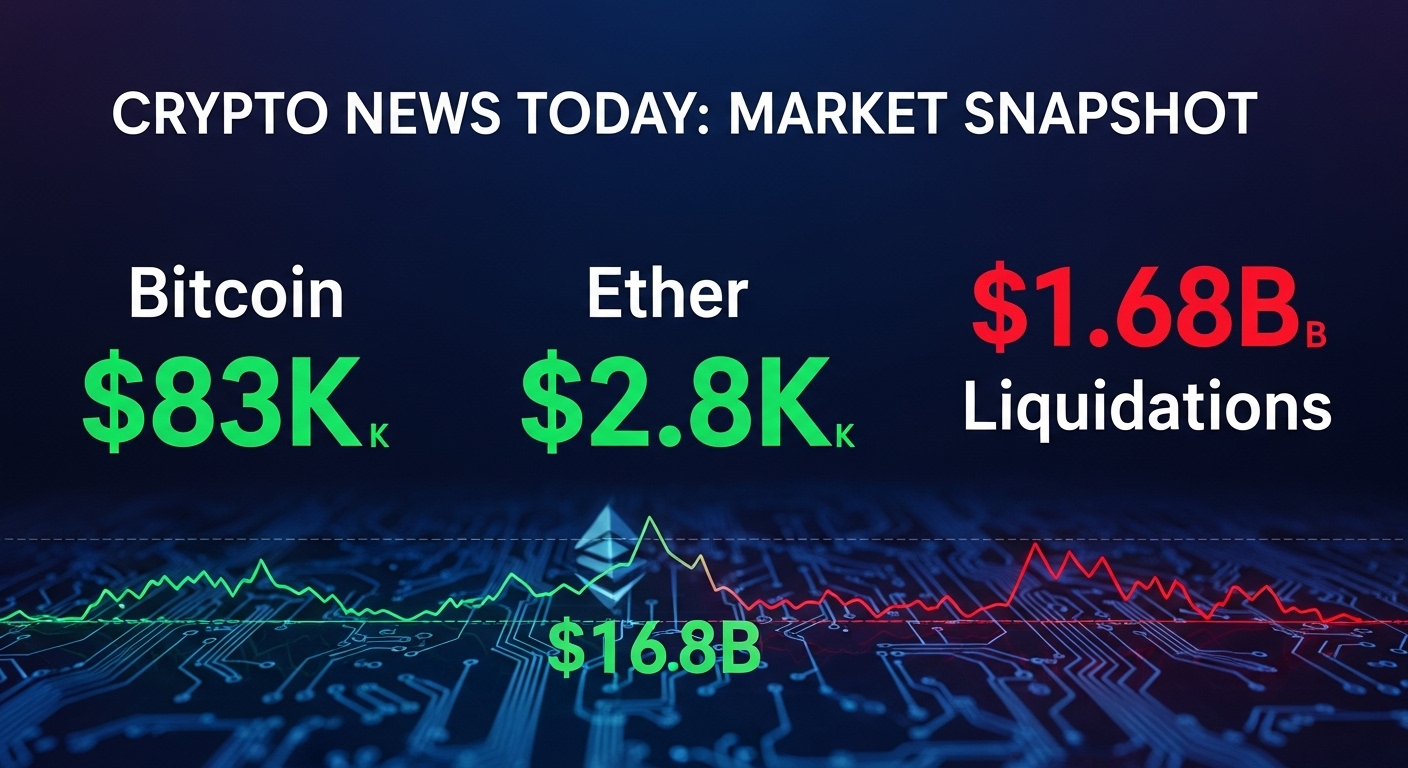
The biggest number in crypto news today, however, is $1.68B. Liquidations at that scale indicate the market was heavily positioned, and that many traders were leaning bullish with leverage. When price started sliding, long liquidations fired, pushing prices lower, which triggered more long liquidations, and so on. That dynamic is why liquidation days feel different from typical red days—they can create a self-feeding decline.
What “liquidations” mean in crypto news today
In crypto news today, liquidations are not just a statistic—they are a mechanism. In leveraged futures markets, traders post collateral to control a larger position. If price moves against them far enough, the exchange closes the position automatically to limit losses. When thousands of accounts hit that threshold at once, the exchange executes large batches of market orders. Those market orders can sweep liquidity quickly, leading to sudden drops and a “falling knife” effect.
This is why crypto news today emphasizes the “leverage wipeout.” A liquidation cascade can temporarily overpower spot demand because the sell pressure is forced. It’s not someone deciding to sell at a reasonable price; it’s a system closing positions at whatever price is available. That distinction explains the speed at which Bitcoin and Ether fell and why the market looked like it was being pulled downward.
Why long liquidations matter more than the headline number
Crypto news today highlights that longs were hit hardest. That matters because it tells you how traders were positioned. A long-heavy liquidation event implies the crowd expected prices to rise or at least hold support. When support breaks in that environment, it’s not only bearish—it’s destabilizing, because everyone tries to exit at the same time.
Long liquidations also tend to create short-term overshoots. Once the forced selling ends, price sometimes stabilizes faster than people expect because the pressure was mechanical rather than purely fundamental. That doesn’t guarantee a rebound, but it does change what to watch: stabilization and reduced volatility become more important than emotional narratives.
Why crypto is down today: leverage, volatility, and a broader risk repricing
Crypto news today isn’t just “Bitcoin fell.” It’s “Bitcoin fell because conditions were ripe for a cascade.” Several forces commonly align before a drawdown like this, and today’s move fits that pattern.
First, leverage builds quietly in sideways markets. When prices chop within a range, traders often increase position size to make the same moves feel “worth it.” That can inflate open interest and create a fragile structure where a single decisive break triggers a chain reaction.
Second, market volatility tends to return suddenly. Crypto can feel calm right before it turns chaotic, especially when liquidity thins and price begins moving quickly between support levels.
Third, correlations rise when risk appetite falls. Crypto news today reflects a broader repricing of risk, where investors reduce exposure across speculative assets. When that happens, crypto trades less like an independent ecosystem and more like a high-beta extension of global risk sentiment.
The “safe haven” debate in crypto news today
A recurring theme in crypto news today is that Bitcoin’s behavior challenges the idea that it always acts as a hedge during stress. In some cycles, Bitcoin behaves like digital gold. In other moments, it trades like a momentum asset—especially when leverage is high and traders are positioned the same way. Today’s slump leans toward the second behavior, and that affects how the market reacts to headlines.
This doesn’t mean the long-term thesis is “broken.” It means short-term flows and positioning often dominate the tape. On liquidation days, narrative takes a back seat to mechanics.
Sentiment swings: fear returns fast
Crypto news today also has a psychological layer. When prices drop sharply and liquidations spike, sentiment can flip from confident to fearful in hours. That shift matters because it changes behavior: traders stop buying dips automatically, spreads widen, and participants become more defensive.
Fear can deepen declines because fewer buyers step in early. But fear can also mark exhaustion when the market has already flushed excessive leverage. In crypto news today, both interpretations are possible, and the market’s next steps—stabilization or continued drift lower—will reveal which one dominates.
Bitcoin price outlook: what to watch after the $83K dip
Crypto news today keeps Bitcoin at the center because BTC is the market’s liquidity anchor. When Bitcoin breaks down, it pulls the entire complex with it. The $83K area matters primarily because it reflects a sharp move into a lower zone where buyers will either defend aggressively or step aside.
The most important concept for crypto news today readers is this: after a liquidation event, the market often shifts from direction to structure. Traders stop asking “up or down?” and start asking “can the market trade normally again?” Normal trading means smaller candles, tighter spreads, and less panic in order books.
How Bitcoin stabilizes after a liquidation cascade
In crypto news today, stabilization usually shows up as a slowdown in the rate of decline. Instead of continuous heavy selling, Bitcoin begins to print smaller moves and starts forming a base. If spot buying appears while futures selling fades, price can hold and gradually rebuild.
Another sign of stabilization is a reduction in “instant dumps” on minor bad news. When the market is fragile, every headline triggers a drop. When the market stabilizes, the same headlines produce smaller reactions. That shift is a clue that forced selling has eased.
The risk of a dead-cat bounce
Crypto news today also needs realism: markets often bounce after violent drops, but not every bounce is a recovery. A dead-cat bounce happens when short covering and bargain hunters push price up briefly, but sellers return as soon as price approaches previous support zones that now act as resistance.
The key is whether the bounce holds. If Bitcoin rallies and then gives back gains quickly, it suggests confidence is still weak. If Bitcoin rallies and consolidates without collapsing, it suggests the market is digesting supply rather than merely reacting.
Ethereum price outlook: why $2.8K is a critical sentiment zone
Crypto news today covers Ether because ETH is not just a coin; it’s the collateral backbone for much of the smart contract economy. When ETH declines, it affects DeFi collateral values, liquidity conditions, and risk limits across on-chain markets.

The $2.8K region matters as a psychological and structural zone because it becomes a reference point for traders evaluating whether ETH is “holding up” or underperforming Bitcoin. If ETH stabilizes and begins to recover relative to BTC, it can signal that the market is willing to take risk again. If ETH keeps bleeding relative to BTC, it can signal that traders are retreating into the most liquid asset first.
Why Ether can move faster after the panic ends
Crypto news today often shows a pattern: ETH can fall hard during panic and then rebound sharply once liquidation pressure fades, because it is a favorite rotation target when traders return to risk. That doesn’t mean ETH is guaranteed to outperform next; it means ETH’s beta is often higher, and higher beta cuts both ways.
The main question after a liquidation event is whether ETH demand is organic or just short-term positioning. Organic demand tends to hold through consolidations. Positioning-driven demand disappears quickly when volatility returns.
Altcoins in crypto news today: why the drawdown spreads across the board
Crypto news today isn’t complete without the altcoin picture. In liquidation cascades, altcoins frequently fall harder than Bitcoin and Ether. The reason is simple: liquidity is thinner, spreads are wider, and fewer buyers are willing to catch falling assets that can drop 10%–20% in minutes.
When BTC drops sharply, many traders sell altcoins to reduce risk quickly, even if the altcoin’s fundamentals haven’t changed. That’s why altcoin charts often look worse on days like this. It’s not always about project news; it’s about portfolio deleveraging and survival behavior.
As crypto news today continues, the altcoin market’s health will depend on whether BTC and ETH stabilize. Altcoins rarely lead recoveries when the majors are still in free fall. They usually follow once the market regains composure.
What happens next in crypto news today: catalysts and conditions to monitor
Crypto news today is “live” because the next 24–72 hours can reshape the narrative quickly. After major liquidations, markets often enter a decision zone. The conditions that matter most aren’t dramatic headlines; they’re practical signals of whether selling pressure is fading.
The first condition is whether liquidation intensity declines. When liquidation days extend into multiple sessions, the market can grind lower because every bounce is sold by shaken traders. When liquidations cool, markets can breathe.
The second condition is whether spot buyers defend key zones. Spot buying is slower and more deliberate than futures trading, but it’s also more durable. If spot demand appears consistently, it can stabilize price even if traders remain nervous.
The third condition is volatility. Crypto news today should be watched through the lens of volatility compression. When volatility stops expanding, the market often begins rebuilding a tradable range.
The role of macro risk sentiment
Crypto news today does not exist in a vacuum. Broader risk sentiment can either fuel or soften crypto’s next move. If global markets remain shaky, crypto can stay under pressure because traders reduce exposure broadly. If global markets stabilize, crypto can rebound faster because a large portion of today’s selling was mechanical.
This is why readers should track both crypto-specific signals and broader market mood. Crypto often amplifies what the rest of the market is already doing.
How to read crypto news today like a pro: avoiding emotional traps
Crypto news today can push people into two common mistakes: panic selling at the bottom and revenge trading on the bounce. Both are rooted in emotion rather than structure.
A healthier approach is to treat liquidation events as information. Liquidations tell you that leverage was too high and that the market has forcibly reduced risk. That can create danger—because volatility remains high—but it can also create opportunity, because forced selling can overshoot.
For long-term investors, crypto news today is a reminder that entries matter less than discipline. A strategy that survives volatility is more valuable than perfect timing.
For active traders, crypto news today reinforces a core truth: leverage must be sized for the worst day, not the best day. The market always has a day where the “impossible” move becomes normal.
Conclusion
Crypto news today on Jan. 30, 2026 is defined by a harsh but familiar episode: a large-scale liquidation cascade that pushed Bitcoin toward $83K and Ether toward $2.8K while roughly $1.68B in liquidations wiped out overleveraged positioning. The damage is real, but so is the reset. When leverage is flushed, the market often becomes structurally healthier—provided volatility stabilizes and spot demand returns.
The next chapter of crypto news today will be written by stabilization signals: whether selling pressure fades, whether Bitcoin can hold a base, and whether Ether regains confidence without triggering another wave of forced unwinds. For readers, the best takeaway is simple: understand the mechanics, respect the volatility, and avoid letting fear or euphoria write your strategy.
FAQs
Q: What caused the $1.68B liquidations in crypto news today?
The biggest driver is a leverage wipeout. When Bitcoin and Ether dropped quickly, leveraged long positions hit liquidation thresholds, triggering forced selling that pushed prices down further.
Q: Does a liquidation cascade mean the bottom is in?
Not necessarily. Crypto news today shows that liquidations can mark capitulation, but markets can still trend lower afterward. A more reliable signal is stabilization: smaller price swings and sustained spot buying.
Q: Why did Bitcoin fall to $83K so fast?
Because forced selling accelerates declines. Liquidations create market orders that hit thin liquidity, causing sharp moves that feel sudden compared with normal selling.
Q: Why is Ether’s $2.8K level important?
It’s a key psychological zone and a market structure reference point. ETH also underpins DeFi collateral, so drops toward $2.8K can affect risk behavior across the ecosystem.
Q: How should beginners react to crypto news today?
Avoid high leverage, don’t chase panic moves, and focus on risk management. Liquidation days are when poor position sizing gets punished the most.
See More: Crypto ETFs Turn Red as Bitcoin and Ether See Fresh Exits
