

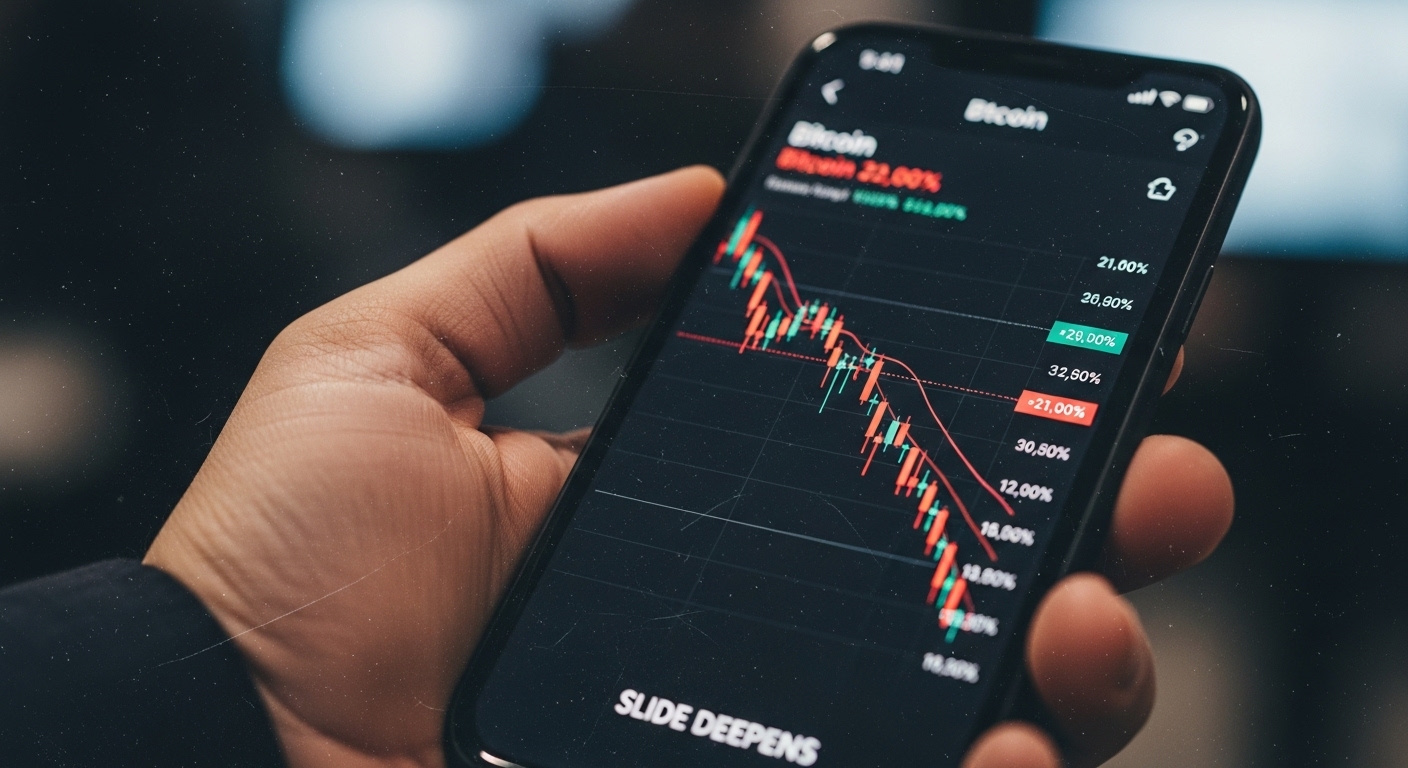
Bitcoin slide can look deceptively simple on the chart: red candles, fading momentum, and a market that suddenly feels heavier than it did just days earlier. But when the Bitcoin slide deepens as BTC/USD squeeze risk builds, the story often goes beyond spot selling. What traders watch in these moments isn’t only price—it’s positioning, leverage, and the subtle pressure building in derivatives markets that can turn an ordinary pullback into a violent move in either direction.
Bitcoin’s unique market structure makes this especially important. Unlike many assets, Bitcoin trades around the clock across global venues, with an enormous ecosystem of perpetual futures, options, and margin products layered on top of spot demand. That structure can amplify both fear and greed. When price drifts lower, leveraged longs can get stressed, liquidations can cascade, and sentiment can sour quickly. At the same time, the very same conditions can prime the market for a sudden reversal if too many participants lean the same way.
That’s the essence of a squeeze setup. In a market where BTC/USD leverage is high, a steady selloff can compress positions and raise the odds of a sharp snapback. As the Bitcoin slide continues, traders start asking the same question: is this just a healthy retracement, or is it the prelude to a breakout move fueled by forced buying and rapid repricing?
In this article, we’ll unpack what it means when the Bitcoin slide deepens as BTC/USD squeeze risk builds, how to read the signs in derivatives, where key technical zones matter most, and what catalysts can flip the tape fast. You’ll also learn how market makers, funding dynamics, and liquidity conditions shape the next move—without resorting to hype or over-optimized buzzwords.
What “BTC/USD Squeeze Risk” Really Means
When people talk about squeeze risk in BTC/USD, they’re usually referring to a short squeeze—a scenario where short sellers are forced to buy back positions as price rises, accelerating the rally. But squeeze risk can also involve long liquidations during a drop, sometimes called a long squeeze, where leveraged buyers get forced out and price dips harder than expected.
In the context of a deepening Bitcoin slide, squeeze risk often grows because the market becomes crowded. If too many traders are shorting the move, a small reversal can ignite a chain reaction. If too many traders are stubbornly long and underwater, another leg down can trigger a liquidation wave. Either way, the “squeeze” is less about emotion and more about mechanics: forced orders hitting the market at speed.
The key idea is that Bitcoin doesn’t move in a vacuum. Spot flows matter, but in many phases the marginal move is driven by derivatives—particularly perpetual futures—because they allow traders to take large positions with relatively little capital. When leverage builds, the market becomes more fragile. That fragility is the fuel that turns a routine dip into a fast move.
The Role of Leverage in a Deepening Bitcoin Slide
Leverage changes the behavior of price. In a low-leverage market, a pullback tends to be gradual because holders can ride volatility. In a high-leverage market, a pullback can become self-reinforcing: price drops, margin erodes, positions get cut, and liquidation engines sell automatically. That selling pressure deepens the Bitcoin slide, which in turn stresses the next layer of leveraged positions.
At the same time, leverage can store energy for the opposite direction. If shorts pile in confidently and price stops falling, the lack of follow-through can spark aggressive buying. When the crowd is positioned for downside continuation and the market refuses to cooperate, a squeeze becomes more likely.
Why “Squeeze Risk Builds” Even While Price Falls
It seems counterintuitive, but squeeze risk can rise during a decline. As Bitcoin slides, traders may chase momentum by shorting, or they may hedge spot exposure with short futures. If the market becomes overly short, there’s a tipping point where sellers are exhausted and price only needs a small catalyst to flip.
This is why the phrase “Bitcoin slide deepens as BTC/USD squeeze risk builds” captures a real phenomenon: weakness can coexist with the ingredients for a sharp rebound. The tape can look bearish while the positioning quietly becomes unstable.
Market Structure: The BTC/USD Engine Behind Volatility
To understand why squeezes happen in BTC/USD, it helps to know what actually moves the market. In many periods, spot buyers and sellers set the baseline. But the pace and magnitude of moves often come from derivatives flows, especially when liquidity is thin.
When volatility rises, market makers widen spreads, order books thin out, and price can jump through levels that would normally act as speed bumps. That’s how a deepening Bitcoin slide can suddenly turn into a fast reversal—because there simply isn’t enough resting liquidity to absorb aggressive orders without major slippage.
Perpetual Futures, Funding Rates, and Crowd Positioning
Perpetual futures are central to Bitcoin price discovery. They trade close to spot using a mechanism called funding rates, which periodically pays longs or shorts depending on which side is more crowded. When funding is strongly positive, it suggests leveraged longs are paying shorts. When funding is negative, shorts pay longs—often signaling bearish crowding.
If the Bitcoin slide pushes funding negative and it stays there while price stabilizes, it can indicate that too many traders are positioned short. That’s when a short squeeze becomes more plausible. Conversely, if funding remains high even during weakness, it may suggest longs are still overcrowded and vulnerable to more downside.
Open Interest and Liquidation Clusters
Open interest measures the total value of outstanding derivatives contracts. Rising open interest during a Bitcoin slide can mean new positions are being added—often shorts chasing downside or longs “buying the dip” with leverage. The important part is the interaction between open interest and price. If open interest increases while price falls, the market may be building a larger spring that can snap when conditions change.
Liquidation clusters form around key technical levels and round numbers. Traders often set similar stop-loss points, and exchanges liquidate positions at predictable thresholds. When price approaches those zones, volatility can surge as liquidations hit the market, sometimes causing a sharp wick followed by a reversal. That’s one of the classic signatures of a squeeze environment in BTC/USD.
Technical Landscape: Support, Resistance, and the Psychology of Levels
Technical analysis isn’t magic, but in Bitcoin it matters because so many participants watch the same levels. In a deepening Bitcoin slide, the market’s attention shifts to where buyers might defend and where sellers might press. The more obvious the level, the more likely it is to attract liquidity—and the more dramatic the reaction can be when it breaks.
Why Support Matters More Than Ever in a Leveraged Market
Support is where demand has historically absorbed supply. During a normal pullback, support zones can produce bounces. But during a leveraged decline, support has an additional role: it’s often where liquidations are concentrated. That means a support test can trigger a sudden flush below the level, followed by rapid buying as forced selling ends.

In other words, support can break briefly even if it “holds” on a closing basis. Traders call this a sweep, a stop run, or a liquidity grab. In a market where the Bitcoin slide deepens as BTC/USD squeeze risk builds, those sweeps become more common because the market is hunting for liquidity.
Resistance Zones and Failed Rebounds
On the way down, prior resistance can become a ceiling that caps relief rallies. These are areas where trapped holders may sell into strength, or where shorts may defend positions. The behavior around resistance is crucial. If a rebound fails quickly and price rolls over, it reinforces bearish momentum. But if price breaks resistance and holds, it can force shorts to cover—one of the earliest signs of a short squeeze.
The most important resistance levels are often those tied to high-volume trading ranges. When Bitcoin re-enters an old range from below, the first attempt is frequently rejected. When it reclaims that range and consolidates, squeeze risk tends to rise rapidly.
Sentiment and On-Chain Signals: Separating Fear From Opportunity
A deepening Bitcoin slide affects sentiment quickly. Social feeds turn pessimistic, traders become reactive, and narratives shift toward worst-case outcomes. While sentiment can be a lagging indicator, extremes matter because they often coincide with crowded positioning.
On-chain metrics can provide additional context, but they should be interpreted carefully. For example, exchange inflows can suggest increased sell intent, while declining exchange balances may hint at long-term accumulation. None of these signals work alone. The most useful approach is to combine sentiment with market structure: if fear rises while funding turns negative and price stops making new lows, squeeze risk can build.
The “Pain Trade” Concept in Bitcoin
Markets tend to move in the direction that causes the most discomfort to the most participants. In a sharp decline, the pain trade can be a sudden rebound that punishes late shorts. In a choppy market, it can be a slow grind lower that drains dip buyers. When the Bitcoin slide deepens as BTC/USD squeeze risk builds, the pain trade often becomes a quick upside move—because many traders get overconfident on continuation and place tight stops above resistance.
Understanding the pain trade doesn’t mean predicting perfectly. It means recognizing that Bitcoin often does what feels least comfortable at turning points, especially when leverage is high.
Liquidity, Market Makers, and Why Moves Accelerate
Liquidity is the hidden variable behind most big BTC/USD moves. When liquidity is abundant, price can travel smoothly and respect levels. When liquidity dries up, price becomes jumpy, and squeezes become more violent.
Market makers provide liquidity by placing bids and offers, but they also manage risk. During heightened volatility, they may pull quotes, widen spreads, or hedge aggressively. That can cause price to gap through levels that would normally slow it down. In a deepening Bitcoin slide, this dynamic can intensify: as uncertainty rises, liquidity can vanish precisely when traders need it most.
Order Book Voids and Sudden Wicks
Order book “voids” are zones with relatively few resting orders. If price enters a void, it can move quickly until it finds a new pocket of liquidity. This is one reason Bitcoin can print large wicks during stressful periods. A small burst of market selling can push price into a thin zone, triggering stops and liquidations, then snapping back once selling pressure is exhausted.
If you’re watching a market where the Bitcoin slide deepens as BTC/USD squeeze risk builds, these wicks aren’t random. They’re often the footprint of liquidity hunting and forced flows.
Catalysts That Can Flip a Bitcoin Slide Into a Squeeze
Even in a technically driven market, catalysts matter because they change behavior quickly. A catalyst doesn’t need to be dramatic news. Sometimes it’s simply a shift in macro tone, a large player stepping in, or a sudden change in derivatives positioning.
For Bitcoin, common catalysts include macroeconomic data, central bank signals, risk-on/risk-off swings, regulatory headlines, major exchange flows, and large options expiries. The important thing is not the headline itself, but how the market is positioned when it hits. When positioning is crowded, a modest catalyst can spark an outsized move.
Options Positioning and Gamma Effects
Options markets can influence BTC/USD through dealer hedging. When large options strikes cluster near current price, dealers may buy or sell spot and futures to stay hedged. This hedging can either dampen movement or amplify it depending on the net exposure.
In practical terms, if the market is hovering near a heavily traded strike during a deepening Bitcoin slide, a small move can trigger hedging flows that accelerate price in the same direction—until it overshoots and reverses. That’s another path to squeeze-like behavior, even without traditional short covering.
Risk Management During a Deepening Bitcoin Slide
When the Bitcoin slide is deepening, the biggest mistake many traders make is treating every dip as identical. A slow retracement in a low-leverage environment is very different from a crowded, high-leverage market where BTC/USD squeeze risk builds.
Managing risk starts with acknowledging uncertainty. The market can continue lower even if conditions look ripe for a bounce. It can also reverse sharply when bearish confidence peaks. Rather than trying to “call the bottom,” it’s more useful to focus on structure: where invalidation levels sit, how volatility is changing, and whether derivatives signals suggest crowding.
Position sizing matters more than entry precision. Wide swings are normal in Bitcoin, and they become more extreme when liquidations are in play. If you’re trading, keeping exposure appropriate for the current volatility regime can be the difference between surviving noise and getting forced out at the worst moment.
What to Watch Next in BTC/USD
When the Bitcoin slide deepens as BTC/USD squeeze risk builds, there are a few core questions that typically decide the next phase.
First, does the market keep making lower lows, or does it start forming a base? A base doesn’t require an immediate rally, but it usually involves slowing downside momentum and a reduction in panic selling.
Second, what happens to funding rates and open interest during consolidation? If funding stays negative while price stabilizes and open interest remains elevated, it can suggest shorts are crowded and a squeeze is more likely.
Third, how does price respond to key support and resistance zones? Clean breakdowns with strong follow-through often signal continuation. Repeated failed breakdowns, especially with sharp bounces, can signal absorption and rising squeeze risk.
Finally, watch liquidity conditions. If spreads widen and order books thin, moves can accelerate. If liquidity improves and volatility compresses, the market may be preparing for a decisive breakout—up or down.
Conclusion
A deepening Bitcoin slide is never comfortable, but discomfort is often where the most important market transitions begin. When the Bitcoin slide deepens as BTC/USD squeeze risk builds, the market is telling you that leverage and positioning are becoming as important as spot demand. The next big move may not be determined by fear alone, but by forced flows—liquidations, short covering, and rapid shifts in liquidity.
The most reliable approach is to watch how BTC/USD behaves around major levels while tracking derivatives signals like funding rates and open interest. A squeeze doesn’t need a dramatic headline; it needs crowded positioning and a trigger. If the market stops rewarding bearish momentum and starts punishing it, the reversal can be fast. And if support fails cleanly with cascading liquidations, the slide can deepen further.
In the end, Bitcoin remains a market where structure and psychology collide. Understanding how squeeze risk builds during a decline can help you stay grounded, avoid emotional decisions, and recognize when a pullback is turning into something bigger.
FAQs
Q: What does it mean when the Bitcoin slide deepens?
When the Bitcoin slide deepens, it usually means selling pressure is persisting and the market is unable to sustain rebounds. This can be driven by spot selling, deleveraging, or liquidations in leveraged markets, especially when volatility rises.
Q: What is a BTC/USD squeeze and why does it matter?
A BTC/USD squeeze is a rapid move driven by forced positioning, often a short squeeze where shorts must buy back as price rises. It matters because squeezes can create explosive rallies (or sharp drops) that move faster than typical trend moves.
Q: How do funding rates help identify squeeze risk?
Funding rates show which side of the perpetual futures market is crowded. Negative funding can suggest shorts are paying longs, which may indicate bearish crowding. If price stabilizes while funding stays negative, squeeze risk can increase because shorts may be vulnerable to a rebound.
Q: Why is open interest important during a Bitcoin slide?
Open interest indicates how much leverage is in the system. Rising open interest during a Bitcoin slide can mean traders are adding positions—often increasing the chance of sharp moves when those positions unwind through stops or liquidations.
Q: Can Bitcoin keep falling even if squeeze risk is high?
Yes. Squeeze risk does not guarantee an immediate reversal. Bitcoin can continue lower if support breaks and forced selling accelerates. Squeeze setups are about probabilities and conditions, not certainties, so it’s important to manage risk and watch confirmation signals in price and derivatives.
Also More: Bitcoin Hashrate Falls 12% After US Winter Storms
