

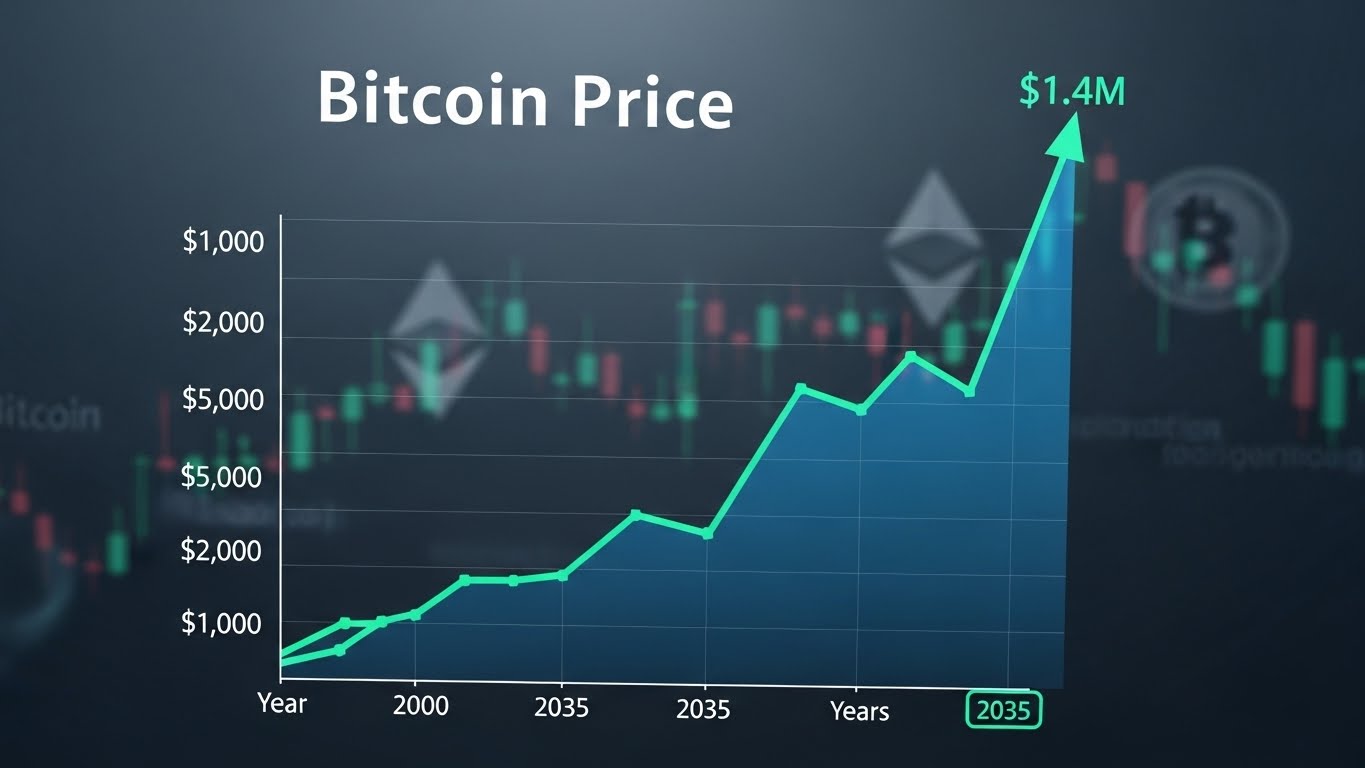
A bold long-term Bitcoin price forecast is easy to dismiss as hype—until it comes from a firm whose job is to build market benchmarks used by institutions. That’s why the latest projection making headlines stands out: CF Benchmarks, a Kraken-owned crypto index provider, argues the Bitcoin price could rise to about $1.4 million by 2035 under a framework designed for serious portfolio conversations, not viral tweets.
CF Benchmarks is not simply “another research blog.” It operates in the plumbing of modern crypto markets, producing reference rates and indices used across regulated products and institutional workflows. When a player like that frames the Bitcoin price as a potential “portfolio staple,” it signals a shift in how professionals model bitcoin’s role alongside stocks, bonds, and gold.
Still, a projection is not a promise. The path from today’s Bitcoin price to a seven-figure valuation would be volatile, politically sensitive, and heavily dependent on adoption trends, macro conditions, and the credibility of market infrastructure. This article breaks down what CF Benchmarks said, how a $1.4M Bitcoin price by 2035 could be modeled, what assumptions must hold for the thesis to work, and what risks could derail it. Along the way, you’ll see why long-horizon Bitcoin price forecasts are less about guessing a number and more about understanding scenarios, probabilities, and portfolio behavior.
The headline claim: $1.4M Bitcoin price by 2035
CF Benchmarks’ projection that the Bitcoin price could reach roughly $1.4 million by 2035 has been reported as part of a scenario-based approach that also includes a lower “bear” path around $637,000 by 2035. In other words, the research isn’t presented as a single-point prophecy. It’s structured as a range of outcomes, reflecting uncertainty while still arguing that even conservative scenarios imply a dramatically higher future Bitcoin price than most people imagine today.
What makes this kind of forecast especially attention-grabbing is the implied scale. A $1.4M Bitcoin price would place bitcoin among the largest financial assets on the planet, demanding serious explanations for where that value comes from. CF Benchmarks’ framing leans into the idea of bitcoin evolving into digital gold, competing in the broader store of value arena where gold, sovereign bonds, and other capital sinks live.
It’s also not happening in a vacuum. In 2025, mainstream investors increasingly discuss bitcoin through institutional lenses—risk models, correlations, volatility assumptions, and allocation sizing—rather than purely ideological narratives. Kraken itself has emphasized this more professionalized approach, including research content focused on factor models and market structure.
Who is CF Benchmarks—and why “Kraken-backed” carries weight
CF Benchmarks is widely known as an index and benchmark provider in crypto markets. Its message matters because benchmarks sit at the center of tradable products: if you have futures, funds, or structured products, you need robust pricing and reference methodologies. CF Benchmarks describes its indices as supporting a wide range of financial products and highlights audit/compliance work and regulated-market usage.
The “Kraken-backed” part is literal. Multiple reputable reports describe CF Benchmarks as acquired by Kraken in 2019, making it a Kraken-owned subsidiary. That ownership link can matter in two ways. First, Kraken is one of the best-known global crypto exchanges, and its corporate incentives align with broader institutional participation in crypto. Second, the acquisition underscores that CF Benchmarks operates at a scale and seriousness that attracts major industry buyers.
None of this guarantees the Bitcoin price reaches $1.4M. But it does increase the signal value: when a benchmark firm models a high Bitcoin price scenario, it often reflects growing demand from professional allocators who want numbers, frameworks, and stress-tested logic—not just enthusiasm.
How firms build long-term Bitcoin price targets without guessing
A common misunderstanding about a long-term Bitcoin price target is thinking it’s a single prediction based on “feelings.” In reality, scenario-based research often starts with a market-sizing idea and then applies assumptions about adoption, penetration, and portfolio allocation. For bitcoin, the dominant versions of this approach tend to revolve around store-of-value market share, institutional adoption, and bitcoin’s fixed supply dynamics.
CF Benchmarks’ reported scenarios are consistent with this logic: treat bitcoin as an asset that could become a durable component in diversified portfolios, then model what level of demand would be required to justify a much higher Bitcoin price over a decade-plus horizon.
The key is that the Bitcoin price becomes an output, not the input. The inputs are questions like: How many institutions allocate? At what percentage? Under what regulation? With what custody standards? And how does bitcoin compete against alternatives like gold, Treasuries, or other safe-haven instruments?
The “portfolio staple” thesis: why allocators may treat bitcoin differently by 2035
Calling bitcoin a “portfolio staple” is a big claim, because staples are assets that appear in many portfolios by default—think broad equity exposure or high-quality bonds. For bitcoin to earn that status, the conversation must move from “Will it survive?” to “How do we size it responsibly?”
That shift is already underway in parts of the market. The development of regulated benchmarks, reference rates, and index infrastructure supports broader participation because institutions need reliable pricing inputs and governance. As this infrastructure matures, institutions can justify strategic allocations to bitcoin as a high-volatility, high-upside diversifier—especially if they believe bitcoin’s scarcity and global liquidity give it a unique role.

This is where the Bitcoin price narrative changes. Instead of short-term catalysts, the story becomes a long, sometimes boring, adoption curve: policies, custody, mandates, committees, and the slow normalization of a new asset class. If that happens, a higher long-term Bitcoin price becomes less about mania and more about persistent demand meeting limited supply.
The adoption engine: ETFs, market plumbing, and credibility
Although CF Benchmarks’ $1.4M Bitcoin price scenario is its own research story, the wider context includes the growth of market infrastructure that makes bitcoin easier to hold in compliant ways. Benchmark providers are a major part of that infrastructure because they feed data into products across the ecosystem.
Other industry research in 2025 has also emphasized institutional pathways. For example, Bitwise published long-term capital market assumptions for bitcoin and discussed how portfolio modeling motivates institutional positioning. You don’t need to agree with Bitwise’s number to see the broader pattern: professionals increasingly talk about Bitcoin price outcomes in terms of modeled returns, volatility, and correlations.
If more capital accesses bitcoin through regulated rails, the potential demand base expands. That doesn’t automatically mean a straight-line Bitcoin price climb, but it supports the “structural bid” narrative: a growing class of long-term holders who buy, rebalance, and hold across cycles.
Supply, halvings, and why scarcity remains central to Bitcoin price models
Bitcoin’s fixed supply is one of the few widely accepted constants in any Bitcoin price forecast. Over time, halvings reduce new issuance, tightening the flow of fresh supply available to the market. While halvings don’t “guarantee” a higher Bitcoin price, they shape the supply-demand math that many models rely on.
By 2035, multiple additional halvings will have occurred, making bitcoin’s issuance rate far lower than it was in the early years. In a world where demand rises even modestly—through institutional adoption, macro hedging, or store-of-value competition—reduced issuance can amplify price sensitivity. That’s why scarcity remains a recurring LSI keyword in long-horizon Bitcoin price discussions: it’s one of the few variables that is relatively predictable.
Still, scarcity alone is not enough. A scarce asset can stagnate if demand fails. So any $1.4M Bitcoin price thesis implicitly assumes demand grows faster than supply availability, and that bitcoin’s role remains socially and politically acceptable in major markets.
The macro backdrop: inflation psychology, debt dynamics, and risk appetite
Long-term Bitcoin price narratives often lean on macro themes: inflation fears, currency debasement anxiety, and the search for assets outside traditional systems. But macro can cut both ways. High real interest rates can pressure risk assets, while economic instability can either boost bitcoin’s safe-haven appeal or trigger liquidity-driven selloffs.
The strongest version of the $1.4M Bitcoin price thesis tends to assume bitcoin increasingly behaves like a global macro asset—something investors hold as part of a broader toolkit, alongside gold, commodities, and other hedges. In that world, bitcoin’s volatility may decline over time as liquidity deepens and long-term holders dominate. If volatility compresses while adoption rises, larger allocators may feel more comfortable with strategic exposure, reinforcing demand and supporting a higher Bitcoin price.
But if macro regimes turn hostile—through harsh regulation, taxation, or capital controls targeting crypto rails—demand could slow, pushing the Bitcoin price toward lower scenarios like the bear path CF Benchmarks referenced.
Valuation ranges and scenario thinking: why $637K to $1.4M is still “one thesis”
Some readers see a range like $637,000 to $1.4 million and think, “That’s too wide to be useful.” In reality, wide ranges are honest when forecasting a new-ish asset across a decade. CF Benchmarks reportedly outlines multiple scenarios through 2035, explicitly including a bear case near $637K.
A better way to interpret this is: CF Benchmarks is describing a family of outcomes driven by adoption intensity and bitcoin’s share of the store-of-value market. Under higher adoption and stronger portfolio integration, the Bitcoin price could cluster around $1.4M (or higher in some external interpretations). Under weaker adoption or harsher conditions, a lower—but still very high—Bitcoin price becomes plausible.
For investors and readers, scenario thinking is useful because it invites better questions. What would have to happen for the Bitcoin price to end up closer to $637K than $1.4M? What regulatory environment, what institutional behavior, what macro regime? These are the questions that help you evaluate the thesis rather than worship the number.
What could derail a seven-figure Bitcoin price
A $1.4M Bitcoin price by 2035 implies bitcoin continues to exist as a widely accessible asset with deep liquidity. Several risk categories could break that assumption.
Regulatory risk remains the most obvious. If major economies restrict exchange access, penalize custody, or treat self-custody as suspicious, adoption could slow sharply. Another risk is technological or market-structure failure: major custody incidents, benchmark credibility issues, or systemic exchange failures could harm trust. This is why benchmark integrity and regulated market linkages matter—institutions require dependable infrastructure before committing capital.
There’s also competition risk. Bitcoin dominates the digital gold narrative today, but narratives evolve. If investors decide other assets fulfill the store-of-value role better, the Bitcoin price could underperform even with fixed supply. Finally, there’s the human factor: market cycles can be brutal. A long bear market can depress interest, funding, and innovation, creating a slower adoption trajectory.
What a $1.4M Bitcoin price by 2035 could mean for everyday investors
It’s tempting to read a $1.4M Bitcoin price projection as an invitation to go “all in.” That’s usually the wrong lesson. The more practical takeaway is that institutions increasingly treat bitcoin as a long-duration bet with asymmetric payoff, but also with non-trivial drawdown risk.
If bitcoin does move toward becoming a portfolio allocation staple, many investors may engage through diversified exposure and disciplined sizing, not through extreme leverage or emotional trading. In that sense, a long-term Bitcoin price thesis can encourage healthier behavior: longer time horizons, better risk management, and more attention to fundamentals like custody, fees, and liquidity.
Importantly, the road matters as much as the destination. Even if the Bitcoin price trends higher over ten years, the path could include multiple 50% drawdowns. Anyone using a 2035 Bitcoin price narrative should prepare mentally and financially for that reality.
How to read Bitcoin price forecasts responsibly
The smartest way to use a long-term Bitcoin price forecast is as a framework for thinking, not a guarantee. First, separate the “why” from the “number.” If the “why” is coherent—growing adoption, better market rails, expanding institutional access—then the thesis may be worth tracking even if the exact Bitcoin price target is wrong.
Second, compare forecasts across methodologies. Some models focus on adoption curves, others on macro hedging, others on network effects. Seeing where different approaches overlap can give you a more grounded sense of what might drive the future Bitcoin price.
Third, remember that forecasts can be self-reinforcing narratives. If enough capital believes a certain Bitcoin price path is plausible, that belief can attract infrastructure and products that make higher valuations easier to sustain. But narratives can flip, too, so always keep humility in your interpretation.
Conclusion
CF Benchmarks’ Kraken-owned research adds an institutional flavor to a conversation that used to be dominated by maximalists and skeptics shouting past each other. Their reported view that the Bitcoin price could reach about $1.4 million by 2035, with a bear scenario near $637,000, reflects scenario-based thinking grounded in portfolio frameworks and the growing institutionalization of crypto markets.
The big message isn’t that $1.4M is inevitable. It’s that the Bitcoin price is increasingly modeled like a real asset in a real financial system—one that could capture meaningful store-of-value demand if adoption, regulation, and infrastructure cooperate. If those conditions weaken, the Bitcoin price could still rise, but not along the most optimistic path. For readers, the best approach is to treat the thesis as a map of possibilities, then manage risk like the outcome is uncertain—because it is.
FAQs
Q: What exactly did the Kraken-backed firm say about Bitcoin price reaching $1.4M?
Reports summarize CF Benchmarks’ view that the Bitcoin price could reach roughly $1.4 million by 2035, presented within scenario analysis that also includes a lower “bear case” around $637,000 by 2035.
Q: Why does CF Benchmarks matter compared to typical crypto influencers?
CF Benchmarks is an index and benchmark provider used in institutional contexts, emphasizing robust indices and regulated-market relevance. Because institutional products rely on credible benchmarks, its research can reflect what professional allocators are asking for when they model Bitcoin price outcomes.
Q: Is CF Benchmarks really Kraken-owned?
Yes. Multiple sources describe CF Benchmarks as acquired by Kraken in 2019, which is why many headlines refer to it as “Kraken-backed” or Kraken-owned.
Q: Does a $1.4M Bitcoin price by 2035 mean bitcoin is guaranteed to outperform?
No. A long-horizon Bitcoin price target is a scenario based on assumptions about adoption, market structure, and macro conditions. CF Benchmarks’ inclusion of multiple scenarios is a reminder that outcomes vary.
Q: What are the biggest risks to the Bitcoin price forecast?
Key risks include regulatory crackdowns, failures in custody or market infrastructure, prolonged bear-market psychology, and competition for the store-of-value narrative. Even with a strong long-term Bitcoin price thesis, the path can include severe volatility and deep drawdowns.
