


The crypto market has entered a phase where sophistication is no longer optional. For years, Bitcoin dominated institutional attention, not just because it was first, but because it offered the deepest liquidity, the cleanest regulatory narrative, and the most developed derivatives ecosystem. Options on Bitcoin matured into an institutional toolkit: a structured way to express views, hedge downside, monetize volatility, and build repeatable trading frameworks. Now, according to STS Digital, that same framework is expanding beyond Bitcoin, as institutions increasingly use the bitcoin options playbook for altcoins to shape exposure across the broader digital asset universe.
This shift is more than a passing trend. It signals a structural evolution in how professional capital interacts with altcoins. In earlier cycles, altcoin trading was often driven by retail narratives, momentum bursts, and high-beta speculation. Institutions largely remained on the sidelines, concerned about liquidity, slippage, and fragmented market structure. But that landscape has changed. Today, major altcoins feature improved exchange infrastructure, greater transparency, more accessible custody solutions, and increasingly liquid derivatives. With that progress, institutions are applying the familiar logic of Bitcoin options markets—volatility surfaces, skew, term structure, gamma positioning, and systematic hedging—to altcoins.
What does this mean for market behavior? It means the altcoin market is gradually becoming less “wild west” and more like a professional arena where price action is influenced by hedging flows, volatility sellers, structured products, and risk-managed exposure. It also means that retail traders, long accustomed to sharp pumps and violent retracements, must now contend with a new layer of market mechanics: option flows can compress volatility, create support or resistance zones, and trigger liquidity cascades when hedges unwind.
In this article, we’ll explore why institutions are adopting the bitcoin options playbook for altcoins, the core strategies behind that playbook, and what it means for liquidity, volatility, and long-term market maturity. We’ll also examine the risks and limitations of applying Bitcoin-style option frameworks to altcoins, and how traders and investors can interpret this shift for smarter decision-making.
Why the “Bitcoin Options Playbook” Matters
Bitcoin options markets became the blueprint for institutional crypto derivatives for one reason: they made risk tradable. Before Bitcoin options achieved meaningful depth, institutions had limited ways to manage exposure beyond spot buying or perpetual futures. Options introduced flexible tools: protective puts for crash insurance, covered calls for yield generation, and spreads for defined-risk trades. Over time, these strategies evolved into a playbook—repeatable approaches guided by volatility analytics and hedging discipline.

This playbook is essentially a professional language for interacting with uncertainty. Institutions don’t just “buy and hold” or “ape in.” They calibrate exposure based on implied volatility, realized volatility, liquidity conditions, and correlation. They build portfolios that can survive multiple scenarios and remain capital-efficient. When STS Digital highlights that institutions are increasingly using the bitcoin options playbook for altcoins, it’s describing the export of this professional trading language into markets that were historically dominated by speculative flows.
The consequences are meaningful. Options markets aren’t just side tools; they can shape spot price behavior. Large option positions can influence dealer hedging, which can amplify trends or dampen volatility. When institutions become consistent participants, they create cycles of supply and demand for volatility itself, changing how altcoins behave through time.
How Institutional Adoption in Altcoins Has Accelerated
The rise of institutional involvement in altcoins didn’t happen overnight. It has been driven by several converging forces that make altcoin options more feasible than before.
First, altcoin liquidity is deeper across more venues. Exchanges and liquidity providers have expanded order book depth and reduced spreads, making it easier for institutions to execute complex strategies with less slippage. Second, crypto market structure has matured, with improved custody, better compliance standards, and more reliable settlement systems. Third, volatility remains abundant in altcoins, which is attractive for institutions that specialize in harvesting volatility risk premia through structured strategies.
Most importantly, Bitcoin paved the path. Institutions already understand options dynamics from traditional markets and learned the unique quirks of crypto through Bitcoin. Once the Bitcoin framework proved reliable, expanding to altcoins became the natural next step. It’s not that institutions suddenly “believe” in every altcoin narrative; it’s that they see more opportunities to express views, hedge exposure, and monetize implied volatility in a wider set of assets.
This is precisely why the bitcoin options playbook for altcoins is becoming such a powerful narrative: it describes institutional behavior that prioritizes structure, not hype.
Core Strategies in the Bitcoin Options Playbook for Altcoins
The phrase “playbook” matters because it implies consistency. Institutions use established strategies with defined objectives, risk limits, and performance expectations. When applied to altcoins, these strategies may look familiar, but the context—liquidity, volatility spikes, and correlation regimes—often changes the way they perform.
Protective Puts and Tail Risk Hedging
One of the most common institutional uses of options is crash protection. Altcoins can experience sharp drawdowns due to macro shocks, regulatory headlines, or ecosystem-specific issues. Institutions holding altcoin exposure—whether through treasury allocations, venture portfolios, or directional trades—often use protective puts to cap downside risk.
This is a major example of the bitcoin options playbook for altcoins: instead of exiting positions entirely during uncertainty, institutions hedge. They treat options as insurance. While this hedging can be expensive when implied volatility is high, it provides psychological and portfolio stability, making institutions more willing to hold altcoin exposure over longer horizons.
Covered Calls and Yield Enhancement
Covered call selling—holding spot and selling call options—is a classic yield strategy in both equities and Bitcoin. Altcoins, with their typically higher volatility, can offer even richer premiums. Institutions can generate yield by selling upside, especially in range-bound or moderately bullish environments.
This isn’t risk-free. If the altcoin rallies aggressively, the covered call seller sacrifices upside. But institutions often prioritize risk-adjusted returns and portfolio yield over maximal upside. When many players adopt this approach, it can create structural “sell pressure” in the options market at certain strikes, shaping how rallies develop.
Volatility Selling and Risk Premia Harvesting
A major institutional edge in derivatives is the ability to sell volatility when it is overpriced relative to expected realized volatility. Crypto markets frequently price fear and excitement into implied volatility. Altcoins, being narrative-sensitive, often trade at elevated implied vol. Institutions can sell volatility through option structures that define risk, such as spreads or collars, to capture volatility risk premia.
This is an important part of the bitcoin options playbook for altcoins, but it comes with unique challenges. Altcoins can gap violently, and liquidity can evaporate during stress. Institutions therefore combine volatility selling with disciplined hedging, strict margin management, and sometimes dynamic delta hedging to avoid blowups.
Spreads, Collars, and Structured Products
Institutions frequently use multi-leg option structures to shape exposure. Spreads reduce cost and define payoff. Collars hedge downside while financing the hedge by selling upside. Structured products can be designed to fit specific mandates such as capital preservation, income generation, or conditional participation.
These strategies become especially relevant in altcoins because implied volatility can be extremely high. Instead of buying outright options at expensive premiums, institutions build structures that reduce cost while maintaining desired protection. The bitcoin options playbook for altcoins is essentially the art of tailoring these structures to the volatility regime.
Why Altcoin Options Are Attractive to Institutions
Altcoin options appeal to institutions for a mix of opportunity and necessity. On the opportunity side, altcoins can deliver higher premiums because the market prices them as riskier. On the necessity side, institutions increasingly have direct or indirect altcoin exposure through funds, venture holdings, or index products—meaning they need hedging tools.
The attraction comes down to three primary dynamics.
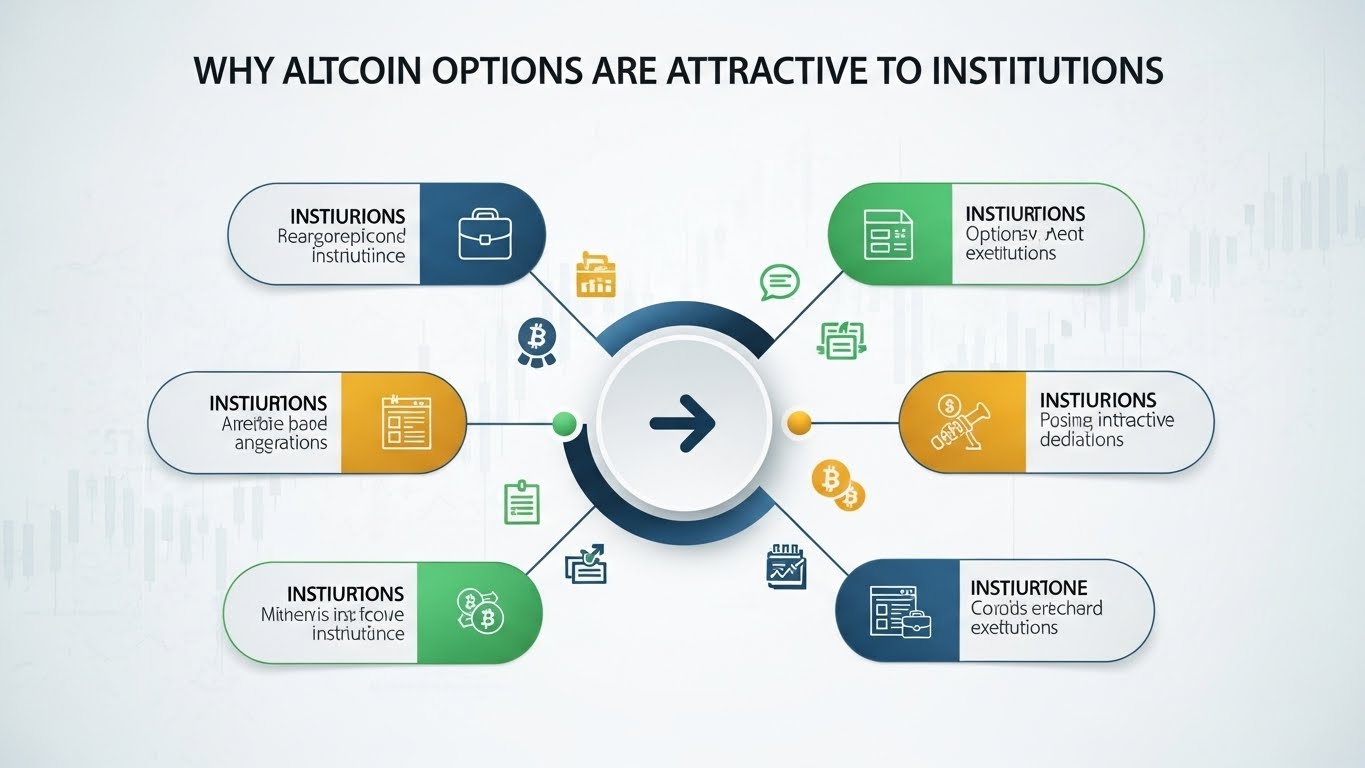
First, altcoin volatility is typically higher than Bitcoin volatility, especially during market transitions. This creates larger option premiums and more potential for options-based income strategies. Second, the altcoin landscape offers diverse narratives—Layer 1 ecosystems, DeFi, gaming, AI, infrastructure—that move differently over time. Institutions can use options to express relative views or hedge sector-specific risk. Third, as derivatives liquidity grows, institutions can execute strategies with greater efficiency, making the bitcoin options playbook for altcoins increasingly viable.
The key is that institutions are not merely speculating. They are building frameworks for risk-controlled participation, turning altcoin exposure into something that resembles professional portfolio management.
Market Impact: How Option Flows Can Shape Altcoin Prices
When options volume increases, spot markets no longer behave the same way. This is one of the biggest implications of institutions using the bitcoin options playbook for altcoins: price action becomes influenced by derivatives positioning.
Options dealers and market makers typically hedge their exposures dynamically. If there is heavy call buying, dealers may need to buy spot as price rises, creating a feedback loop. If there is heavy put buying, dealers may sell spot as price falls, amplifying downside moves. This dynamic can create periods of gamma-driven price action, where movements accelerate around key strikes.
Additionally, large open interest at specific option strikes can lead to “pinning” behavior near expiration. When institutions trade structured products, they often cluster around certain maturities and strikes, which can influence where price gravitates as expiry approaches.
Over time, these flows can produce more “institutional” price behavior: smoother trends during normal conditions, punctuated by sharp moves when hedges unwind or volatility spikes. Altcoin traders who ignore options flows may find themselves surprised by sudden accelerations or unexpected stability.
Differences Between Bitcoin Options and Altcoin Options
Even as institutions apply the bitcoin options playbook for altcoins, it’s important to understand that altcoin options are not simply Bitcoin options with a different ticker. They come with distinct market structure risks.
Altcoin liquidity is often thinner. Even large altcoins may not match Bitcoin’s depth, particularly for longer-dated options. This can make it harder to enter and exit positions without moving the market. Altcoins are also more prone to idiosyncratic risk: protocol exploits, governance controversies, token unlocks, or liquidity drains can create abrupt repricing events that standard volatility models may not anticipate.
Correlation regimes also differ. In some periods, altcoins are highly correlated with Bitcoin, behaving like leveraged beta. In other periods, correlations break down as narratives dominate. This matters for hedging strategies. A hedge based on Bitcoin assumptions may fail in an altcoin-specific shock. Institutions adopting the bitcoin options playbook for altcoins must therefore adapt with tighter risk controls, better scenario analysis, and more conservative sizing.
What This Means for Retail Traders and Long-Term Investors
For retail participants, the rise of institutional options strategies in altcoins changes the game. Markets that were once driven largely by spot flows and perpetual funding dynamics may increasingly reflect options positioning and hedging behavior.
Retail traders who rely on technical analysis alone may miss crucial drivers such as large open interest strikes, implied volatility shifts, and dealer gamma. Understanding these dynamics doesn’t require becoming a professional derivatives trader, but it does mean recognizing that options market liquidity can influence spot outcomes.

For long-term investors, the trend is more constructive. Institutions using the bitcoin options playbook for altcoins can stabilize markets by adding two-way flow, increasing liquidity, and encouraging more mature price discovery. However, it can also introduce complexity: sudden volatility compression may make breakouts less explosive, while hedging-driven cascades may intensify selloffs when protection is unwound.
Ultimately, this evolution suggests that altcoins are slowly graduating from pure speculative instruments into assets that can be managed and hedged within professional portfolios.
Risks and Limitations of the Bitcoin Options Playbook for Altcoins
No playbook is perfect, and applying Bitcoin strategies to altcoins introduces unique risks.
Liquidity fragmentation remains a major concern. Altcoin options trading may be split across venues, and liquidity can disappear in stressed markets. Implied volatility can also be unstable, shifting rapidly due to narrative-driven sentiment. This can lead to volatility regime shifts that break assumptions behind common strategies such as short volatility or yield harvesting.
Counterparty and venue risk is another factor. Institutions typically prioritize regulated or reputable venues, but crypto derivatives infrastructure still varies in quality and oversight. Additionally, altcoin-specific events can create sudden discontinuities in price that options models may not handle well.
The most important limitation is behavioral: institutions may adopt the bitcoin options playbook for altcoins, but not all altcoins will benefit equally. Capital tends to concentrate in the most liquid and widely held assets. Smaller tokens may remain largely retail-driven and continue to behave in unpredictable ways, with limited options influence.
How Altcoin Options Could Evolve
If current trends continue, altcoin options markets may become a major pillar of crypto derivatives. Institutional participation tends to attract more liquidity providers, which reduces spreads, improves execution, and encourages further growth. Over time, this can lead to more developed volatility surfaces, more reliable term structures, and deeper long-dated markets.
We may also see increased adoption of structured products tied to altcoins, especially for wealth management and crypto-native funds seeking yield and defined risk. As these products grow, options flows could become one of the most important drivers of altcoin market behavior, much like they are in Bitcoin.
The larger implication is that crypto markets are professionalizing. The spread of the bitcoin options playbook for altcoins signals that institutions are not just dabbling—they are building frameworks for sustained participation.
Conclusion
The idea that institutions are increasingly using the bitcoin options playbook for altcoins, as highlighted by STS Digital, reflects a broader market transformation. Altcoins are no longer just speculative side quests in the crypto ecosystem. They are becoming assets that institutions can hedge, structure, and manage with strategies that were previously reserved for Bitcoin.
This shift brings both opportunity and change. It can increase liquidity, improve price discovery, and encourage more stable market participation. But it also introduces new mechanics—dealer hedging, implied volatility dynamics, and strike-driven price behavior—that reshape how altcoins move.
For traders and investors, the lesson is clear: understanding options isn’t just for professionals anymore. As institutional playbooks expand, the altcoin market becomes increasingly influenced by derivatives flows. Those who adapt to this reality will be better positioned to navigate the next phase of crypto market maturity.
FAQs
Q: What does “bitcoin options playbook for altcoins” mean?
It refers to institutions applying proven Bitcoin options strategies—such as protective puts, covered calls, volatility selling, and structured spreads—to altcoins. The approach focuses on hedging, yield generation, and risk-controlled exposure rather than pure speculation.
Q: Why are institutions interested in altcoin options now?
Altcoin liquidity and derivatives infrastructure have improved, and many altcoins offer higher implied volatility, which can mean richer option premiums. Institutions also increasingly hold altcoin exposure and need more sophisticated hedging tools.
Q: Can options activity really affect altcoin spot prices?
Yes. Dealers often hedge options exposure by buying or selling spot or perpetuals. Large option positions at key strikes can influence price behavior through gamma hedging, volatility flows, and expiration-related dynamics.
Q: Are altcoin options riskier than Bitcoin options?
Generally, yes. Altcoins often have thinner liquidity, higher volatility, and greater idiosyncratic risk such as protocol events, token unlocks, or sudden narrative shifts. That’s why institutional sizing and risk controls matter even more in altcoins.
Q: How can retail traders benefit from this trend?
Retail traders can improve decision-making by tracking factors like open interest, implied volatility, and major strike levels. Even a basic understanding of option-driven market mechanics can help interpret why altcoins sometimes move sharply—or unexpectedly stabilize—around key moments.
Also More: Bitcoin Price Prediction ETFs Outflows Spark $80k Fears
