


Bitcoin has a way of making weekends feel louder than weekdays. It’s not always because the price moves more, but because the market structure changes. As major institutions, desk traders, and a large portion of traditional liquidity providers step back, weekend liquidity becomes thinner and more sensitive. That shift can turn an otherwise ordinary consolidation into a sharper breakout, a sudden wick, or a fast rejection that seems to appear out of nowhere.
Right now, the focus is narrowing around two levels that traders repeatedly return to when volatility compresses: $98,200 and $107,500. The first is being watched as a key support level—a line in the sand where buyers have shown they’re willing to defend price. The second is a notable resistance zone, a region that could become a magnet if bullish momentum accelerates and stops begin to stack above the market.
This matters because Bitcoin doesn’t trade in a vacuum. Price is the final output of competing forces: spot demand, derivatives positioning, macro headlines, and—crucially—market depth. When depth shrinks, the path of least resistance becomes more influential. In practical terms, it takes less volume to move BTC, and that’s why weekends can produce exaggerated reactions to levels that might hold cleanly during high-liquidity sessions.
In this article, we’ll break down why Bitcoin’s ability to hold support is so important as the weekend sets in, what makes $98,200 significant, why $107,500 remains a pivotal upside target, and how traders can think about risk when liquidity is limited. Along the way, we’ll weave in BTC price action, order book dynamics, on-chain signals, and derivatives funding—not as buzzwords, but as tools to understand what’s happening beneath the chart.
Why Weekend Liquidity Changes Bitcoin’s Behavior
Bitcoin trades 24/7, but market participation does not stay constant across the week. On weekdays, more capital tends to sit near the market—market makers quote tighter spreads, larger players execute systematically, and arbitrage keeps price relationships closer across venues. When the weekend arrives, spreads can widen and the order book can thin out, especially at key price clusters where many participants place limit orders.
This does two things to Bitcoin. First, it increases the chance of sharp wicks. A relatively modest market order can sweep multiple levels when there aren’t enough resting bids or asks. Second, it amplifies the importance of well-known support and resistance. Because liquidity pools around these zones, price often accelerates into them and then reacts quickly—either bouncing as bids absorb, or slicing through as stops cascade.
The result is a market where Bitcoin can look calm for hours and then move abruptly. That’s why support at $98,200 becomes more than a number. It becomes a battleground where the market proves whether buyers are truly committed or simply opportunistic. Similarly, $107,500 becomes more than a target—it becomes a pressure point where sellers may defend, longs may take profit, and breakouts may trigger new momentum.
The Role of Market Depth and Spread
Market depth is the amount of buy and sell liquidity available at different prices. In deeper markets, there is more “cushion” against sudden moves. In thinner markets, there’s less cushion, so price can travel faster and farther.
During weekend conditions, Bitcoin often experiences wider spreads and lower depth, particularly on certain exchanges or pairs. That’s why BTC price can briefly dip below support and reclaim it, or tag resistance and snap back. These moves aren’t always “fake”; they are sometimes simply the market exploring liquidity in an environment where liquidity is scarce.
Liquidity Hunts and Stop Clusters
When liquidity is thin, the market can become more sensitive to clustered stop-loss orders. If price sits near a widely watched level—like $98,200—many traders place stops just below it. If Bitcoin dips into that area, those stops can trigger market sells that push price lower, which can trigger more stops, creating a chain reaction.
This phenomenon—often described as a liquidity sweep—is one reason why Bitcoin’s weekend action can appear erratic. The key is not to assume every dip below support is a breakdown or every spike above resistance is a real breakout. The context—depth, volume, and reaction speed—matters.
Bitcoin’s $98,200 Support: What Makes It “Key”?
Support is not just a line drawn on a chart. It’s a zone where buy-side interest has repeatedly outmatched sell pressure. When Bitcoin holds a support like $98,200, it signals that participants are comfortable accumulating there or defending open positions. When Bitcoin loses it decisively, it suggests the opposite: that bids are either exhausted or stepping aside.
$98,200 stands out because it functions as a psychological and structural level. Psychologically, it sits near a round-number region where traders naturally anchor decisions. Structurally, it often aligns with prior consolidation, short-term moving averages, or previous reaction lows depending on the timeframe being analyzed. That convergence is what makes it “key”: multiple groups of market participants see it, and that shared attention can reinforce reactions there.
When Bitcoin holds a level like $98,200 into the weekend, it often becomes the base for two possible scenarios. The first is a gradual grind higher as sellers fail to push through support. The second is a sharper weekend push lower to test deeper liquidity—followed by a reclaim if the move is primarily a stop-hunt rather than a true shift in demand.
What “Holding Support” Really Means
It’s tempting to define holding support as “price didn’t go below it.” But Bitcoin frequently wicks below support and still holds it in a meaningful way. A more practical definition is this: Bitcoin holds support if it can reclaim the level quickly and continue to close candles above it, showing that buyers are absorbing supply.
In thin liquidity conditions, Bitcoin may momentarily breach $98,200 and then recover. That recovery can be more important than the breach. A fast reclaim suggests strong demand. A slow crawl back—or repeated failures to reclaim—suggests weakening bids.
Volume and Confirmation Without Overreacting
Confirmation does not require perfection. With weekend liquidity, you’re often dealing with smaller sample sizes and less reliable volume signals. Still, relative volume can help: if Bitcoin bounces from $98,200 with increasing participation, it suggests the level has real defenders. If the bounce occurs on noticeably weak volume, it may indicate the market is simply drifting rather than decisively reversing.
The key is to watch what happens after the bounce. Does BTC continue building higher lows, or does it return to retest $98,200 repeatedly? Multiple retests can strengthen support—until they don’t. Too many tests can eventually wear buyers down.
The $107,500 Resistance: Why It’s a Magnet for Volatility
If $98,200 is the floor traders watch, $107,500 is the ceiling that shapes expectations. Resistance levels matter because they often coincide with previous selling pressure, profit-taking zones, or areas where bearish participants feel comfortable entering shorts with defined risk.
$107,500 is also significant because it can act as a volatility trigger. If Bitcoin begins moving toward it, traders anticipate reactions. Some will front-run it with sell orders. Others will wait for a breakout and buy the move. This split creates two-way pressure, and two-way pressure is what produces sharp candles.
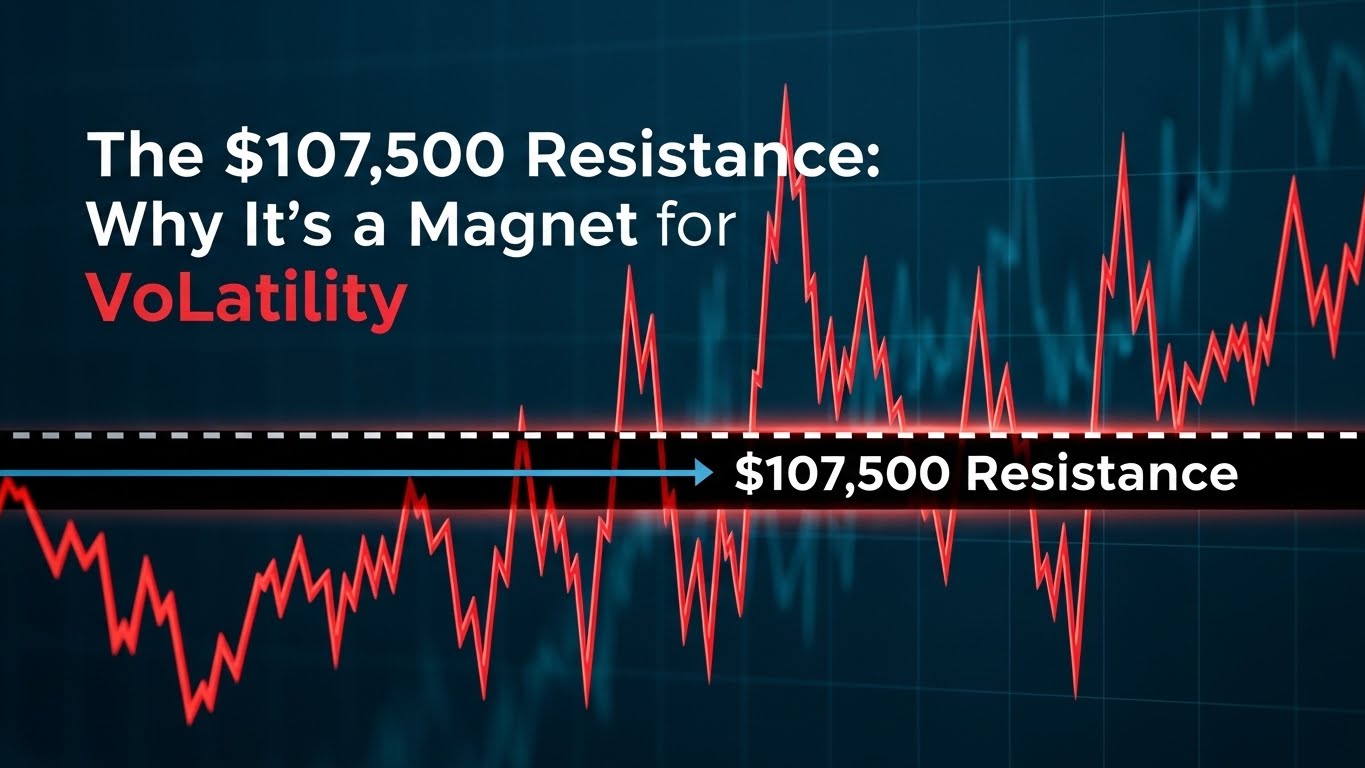
From an order flow perspective, resistance zones often contain stacked limit sells. If Bitcoin approaches $107,500 and stalls, it may indicate those sells are absorbing bids. If Bitcoin pushes through and holds above, it suggests the sell wall is being eaten, and price discovery becomes possible.
Breakout vs. Rejection: The Difference Is the Retest
A true breakout in Bitcoin usually isn’t just a wick above resistance. It’s a move above that level followed by acceptance—meaning BTC holds above and uses the old resistance as new support.
In this case, acceptance above $107,500 would look like Bitcoin clearing the level, pulling back modestly, and then bouncing from the same region. That bounce signals that what used to be supply is now demand.
A rejection, by contrast, often looks like a spike into resistance, followed by rapid selling and a return to the prior range. In weekends, rejections can be sharper because liquidity above resistance can be thin, allowing a quick wick that fails.
Why Traders Watch “Round Zones” Around Resistance
Even though $107,500 is a specific figure, market behavior often clusters around zones rather than exact ticks. Traders tend to place orders slightly above or below round figures, leading to choppy behavior around the level. That means Bitcoin may oscillate in the neighborhood of $107,500 before choosing direction.
This is why patience matters. The market often gives multiple “tests” of resistance, and the final move is the one that traps the most participants who committed too early.
How Derivatives Positioning Can Shape Weekend Moves
Spot markets matter, but derivatives often dictate speed. Perpetual swaps and futures allow traders to take leveraged exposure, and leverage can accelerate liquidations when price moves into crowded positioning.
If Bitcoin is hovering near support at $98,200 and there’s heavy leveraged long exposure, a dip can trigger forced selling as positions get liquidated. That liquidation can push BTC below support briefly, even if spot demand remains intact. If the move clears out leverage and price reclaims support, it can set the stage for a healthier rebound.
On the upside, if Bitcoin pushes toward $107,500 while shorts are crowded, a breakout can trigger a short squeeze, forcing shorts to buy back and fueling momentum. In low liquidity, squeezes can be fast and dramatic.
Funding Rates and Sentiment Signals
Derivatives funding can provide a clue about positioning. When funding is high, longs may be paying shorts, indicating bullish crowding. When funding flips negative, shorts may be paying longs, indicating bearish crowding.
Funding alone doesn’t predict direction, but it helps frame risk. A heavily long-biased market sitting right above $98,200 is more vulnerable to a downside sweep. A heavily short-biased market pressing into $107,500 is more vulnerable to a squeeze.
Open Interest and “Fragile” Price Moves
Open interest represents the total number of outstanding derivatives contracts. When open interest rises rapidly without corresponding spot volume, the move can be fragile—powered more by leverage than by real demand.
In weekends, fragile moves can reverse quickly. That’s why traders often look for BTC price action that shows acceptance, not just expansion. Acceptance is what survives the return of weekday liquidity.
On-Chain and Spot Demand: The Quiet Force Behind Support
While derivatives can shape short-term spikes, spot demand and longer-term holders often determine whether support truly holds. On-chain data can sometimes hint at whether accumulation is occurring or whether distribution is underway, though it should be interpreted cautiously and in context.
If Bitcoin is holding $98,200, one supportive narrative is that longer-term participants are using dips to accumulate. Another is that exchange balances are not surging, implying there isn’t a strong rush to sell. These aren’t guarantees, but they can add weight to a support thesis when aligned with price behavior.
Spot demand can also be influenced by broader catalysts like institutional inflows, macro sentiment, or shifts in risk appetite. Even without a single headline, the market can exhibit steady bid strength that keeps BTC above a key level.
The Difference Between “Organic” and “Mechanical” Bounces
A mechanical bounce is driven by technical triggers: stops, liquidations, and quick mean reversion. An organic bounce is driven by sustained buying that continues after the initial reaction.
When Bitcoin bounces from $98,200, an organic bounce tends to show follow-through: higher highs, stronger closes, and reduced volatility on pullbacks. Mechanical bounces tend to snap back quickly and then stall, often returning to retest the same support.
Scenarios to Watch: What Happens Around $98,200 and $107,500
As weekend liquidity sets in, Bitcoin tends to gravitate toward the most obvious levels because that’s where liquidity sits. With $98,200 acting as the key support and $107,500 acting as the key resistance, the market often oscillates between defense and expansion.
If Bitcoin continues to hold $98,200, the probability of a grind upward increases, especially if sellers fail to create lower lows. The market may slowly build pressure as shorts enter prematurely and get forced out during higher pushes. In that context, $107,500 becomes the logical upside test.
If Bitcoin loses $98,200 and fails to reclaim it, traders often start looking for the next demand zone below, where price previously consolidated or where buyers stepped in before. The exact level will depend on recent structure, but the concept is consistent: once a key support breaks, Bitcoin typically searches for deeper liquidity.
What “Acceptance” Looks Like in Both Directions
Acceptance is the market’s way of saying, “This level is now fair value.” Below $98,200, acceptance would look like Bitcoin trading under the level for an extended period and failing to reclaim it on rebounds. Above $107,500, acceptance would look like Bitcoin holding that region as support after a breakout.
When acceptance occurs, follow-through becomes more likely because the market has moved its reference point. In weekends, acceptance can be harder to confirm due to lower participation, so traders often look for clean closes and consistent behavior across multiple candles rather than reacting to a single wick.
Risk Management Considerations in Thin Weekend Markets
Even experienced traders treat weekends differently because volatility can be deceptive. Bitcoin can move quickly, but that doesn’t always mean the move will persist. Thin liquidity can produce false breaks that reverse once weekday liquidity returns.
A practical approach is to prioritize clarity over speed. If Bitcoin is chopping around $98,200, it may be wiser to wait for confirmation—such as a clear reclaim after a sweep or a clean breakdown with sustained acceptance below. If Bitcoin approaches $107,500, it may be wise to watch how price behaves at the level rather than assuming a breakout.
This is not about being cautious for its own sake. It’s about respecting the structure of a market that changes as participation changes. Bitcoin is still Bitcoin on the weekend, but the battlefield is smaller, and that makes every push feel bigger.
Conclusion
Bitcoin holding key support as weekend liquidity sets in is a classic setup for heightened sensitivity around major levels. With $98,200 acting as a crucial support zone and $107,500 standing out as a defining resistance, the market is effectively boxed between defense and expansion. In thin conditions, Bitcoin can wick, sweep liquidity, and snap back quickly—making context more important than any single candle. Watching whether BTC can repeatedly reclaim and close above $98,200, and whether it can approach and accept above $107,500, provides a structured way to interpret the next move. Ultimately, weekend price action is less about predicting and more about reading reactions—because in Bitcoin, the reaction at the level often tells the real story.
FAQs
Q: Why does Bitcoin volatility sometimes increase on weekends?
Bitcoin volatility can increase on weekends because weekend liquidity is often thinner, spreads can widen, and fewer large participants are active. With less depth in the market, smaller orders can move price more dramatically, leading to sharper wicks and quicker reversals.
Q: What makes $98,200 an important Bitcoin support level?
$98,200 is important because it can represent a zone where buyers have previously defended price and where multiple traders anchor decisions. When Bitcoin consistently reclaims and closes above this region after dips, it signals meaningful demand rather than a temporary bounce.
Q: Why is $107,500 a major resistance for BTC?
$107,500 is viewed as a major resistance because it may align with prior selling pressure and profit-taking behavior. It can also act as a volatility trigger, where a breakout could accelerate due to stop orders and a potential short squeeze in derivatives markets.
Q: How do derivatives affect Bitcoin moves near support and resistance?
Derivatives can amplify moves when leverage is crowded. Near support like $98,200, a dip can trigger liquidations that temporarily push price lower. Near resistance like $107,500, a breakout can force shorts to cover, accelerating upside momentum through mechanical buying pressure.
Q: How can traders avoid getting trapped by weekend Bitcoin wicks?
Traders often avoid traps by focusing on confirmation rather than reacting to a single wick. In thin weekend markets, it helps to watch for acceptance—such as sustained closes above $98,200 after a sweep or stable trading above $107,500 after a breakout—before assuming a move is real.
Also More: Bitcoin Price Analysis Can BTC Break $100K Next Week?
