

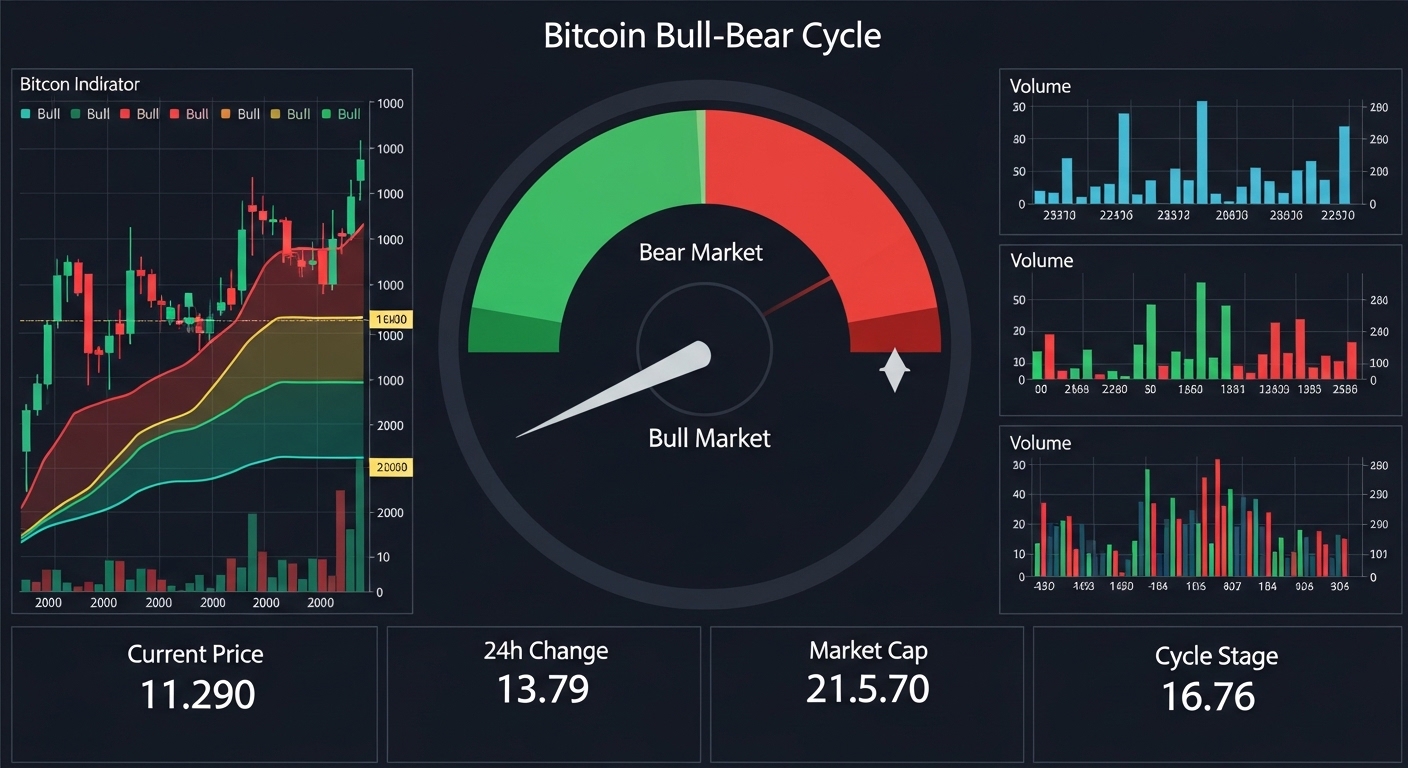
Bitcoin markets have always moved in cycles, swinging between periods of euphoria and despair. While price charts tell one part of the story, seasoned investors increasingly rely on on-chain indicators to understand what is happening beneath the surface. One of the most closely watched tools today is the Bitcoin bull-bear cycle indicator, which has now dropped to its deepest level since the infamous FTX bottom.
This development has sparked intense debate across the crypto community. Some see it as a warning sign that Bitcoin may be entering another prolonged bearish phase. Others believe it signals exhaustion in selling pressure and the potential foundation for the next major recovery. Either way, when the Bitcoin bull-bear cycle indicator reaches extreme levels, it deserves careful attention rather than emotional reactions.
In this article, we’ll explore what the Bitcoin bull-bear cycle indicator actually measures, why its plunge to FTX-era depths matters, how it fits into Bitcoin’s broader market cycles, and what this signal could mean for traders and long-term investors alike. By the end, you’ll have a clearer framework for interpreting this indicator without falling into fear-driven or hype-driven decisions.
Bitcoin bull-bear cycle indicator
The Bitcoin bull-bear cycle indicator is designed to identify whether the market is operating in a bullish or bearish regime based on underlying momentum and profitability. Unlike simple trend indicators that rely only on price, this metric incorporates on-chain data to reflect how participants are actually performing.
At its core, the indicator compares short- and long-term profitability trends. When the market is healthy, most holders are in profit, momentum is strong, and confidence supports higher prices. During these periods, the Bitcoin bull-bear cycle indicator stays in positive territory or trends upward. When conditions deteriorate, profitability declines, momentum weakens, and fear begins to dominate, pushing the indicator into negative territory.
Why this indicator stands out from traditional metrics
What makes the Bitcoin bull-bear cycle indicator unique is its ability to capture shifts in market psychology before they are fully visible in price action. Bitcoin can sometimes appear stable on the surface while internal data reveals stress building underneath. Conversely, price may look weak even as selling pressure quietly fades.

By focusing on profitability and momentum, the indicator helps investors distinguish between normal volatility and genuine regime shifts. This makes it especially valuable during uncertain periods, when emotional decision-making tends to peak.
What “deepest since FTX bottom” really means
The FTX collapse marked one of the darkest moments in Bitcoin’s history. It wasn’t just a price crash—it was a crisis of trust. Liquidity dried up, leverage imploded, and confidence across the crypto market collapsed almost overnight. Bitcoin reached multi-year lows as panic selling took hold.
When the Bitcoin bull-bear cycle indicator falls to its deepest level since that period, it signals that internal market conditions now resemble those extreme stress levels. This does not mean price must revisit those lows, but it does suggest that momentum and profitability have deteriorated sharply.
How Bitcoin market cycles influence the indicator
Bitcoin is often described as moving in multi-year cycles, shaped by adoption trends, liquidity conditions, and investor psychology. While these cycles are influenced by events like halvings, they are ultimately driven by human behavior. The Bitcoin bull-bear cycle indicator acts as a mirror to this behavior.
During early bull markets, optimism builds slowly. Price rises, but skepticism remains. As confidence grows, momentum accelerates and profitability expands, pushing the indicator higher. Eventually, euphoria sets in, often followed by excess leverage and unrealistic expectations. When reality fails to meet those expectations, the cycle reverses.
Bear markets and capitulation phases
In bearish phases, the indicator tends to decline steadily. Rallies fail, confidence erodes, and participants who entered late in the cycle experience mounting losses. This is where capitulation often occurs—when selling becomes emotionally driven rather than rational.
The Bitcoin bull-bear cycle indicator reaching extreme lows often coincides with these moments of capitulation. Historically, such conditions have marked periods when weak hands exit the market, leaving behind a more resilient base of long-term holders.
Sideways markets and prolonged weakness
Not all downturns end quickly. Sometimes Bitcoin enters long periods of sideways price action. While price may not collapse further, momentum remains weak and enthusiasm fades. In these environments, the Bitcoin bull-bear cycle indicator can stay depressed for months, reflecting the market’s lack of conviction. This is why the indicator should be interpreted as a contextual tool rather than a precise timing signal.
Key reasons behind the current plunge
Several forces can drive the Bitcoin bull-bear cycle indicator to extreme lows. Understanding these forces helps clarify whether the signal represents danger, opportunity, or both.
Shrinking profitability across holders
One major factor is declining profitability. When Bitcoin trades below the average cost basis of a large portion of holders, selling pressure tends to increase. Short-term holders become more sensitive to losses, while new buyers hesitate to step in. As profitability compresses, momentum weakens, dragging the Bitcoin bull-bear cycle indicator lower. This process can accelerate during sharp price drops or extended periods of consolidation.
Leverage unwinding and risk reduction
Another contributor is deleveraging. During strong bull markets, leverage builds quietly. When price reverses, forced liquidations can intensify declines. Even after the initial sell-off, traders often reduce risk exposure, leading to lower trading volumes and weaker momentum. The indicator reflects this shift as speculative appetite fades and the market transitions into capital preservation mode.
Broader risk-off sentiment
Bitcoin does not exist in isolation. Global financial conditions, monetary policy expectations, and investor risk appetite all influence crypto markets. When broader sentiment turns cautious, capital often flows away from high-volatility assets like Bitcoin. This environment can suppress rallies and keep the Bitcoin bull-bear cycle indicator pinned near bearish extremes.
How to interpret this signal without panic
Seeing the Bitcoin bull-bear cycle indicator at its deepest level since the FTX bottom can feel alarming. However, reacting emotionally often leads to poor decisions. The key is understanding what the indicator is telling you—and what it isn’t.
What the indicator is saying
The indicator is signaling that the market is under significant stress. Momentum is weak, profitability has declined, and confidence is fragile. This is not an environment where aggressive speculation tends to be rewarded.
What the indicator is not saying
It is not predicting an exact bottom or guaranteeing further downside. Extreme readings can persist longer than expected, but they can also precede powerful reversals. Context matters. The most useful insight comes from watching how the indicator behaves after reaching extreme levels. Stabilization or gradual improvement often signals that selling pressure is easing.
Using the Bitcoin bull-bear cycle indicator as a trader

For active traders, the Bitcoin bull-bear cycle indicator works best as a regime filter rather than a trade trigger. In bullish regimes, breakout strategies and trend-following approaches tend to perform well. In bearish regimes, those same strategies often fail. When the indicator is deeply negative, traders may shift toward shorter timeframes, tighter risk controls, or reduced position sizes. Patience becomes a competitive advantage during these periods.
Using the indicator as a long-term investor
Long-term investors view the Bitcoin bull-bear cycle indicator through a different lens. Extreme bearish readings often align with periods of maximum pessimism, when future returns may improve simply because expectations are low. This does not mean buying blindly. Instead, many investors use such signals to begin gradual accumulation strategies, spreading risk over time rather than attempting to pick exact bottoms. Historically, some of the best long-term opportunities have emerged when sentiment was weakest and conviction was scarce.
What happens next for Bitcoin?
When the Bitcoin bull-bear cycle indicator reaches levels last seen during the FTX bottom, the market typically faces one of three paths. In some cases, Bitcoin stabilizes and begins a slow recovery as selling pressure fades. In others, price moves sideways for an extended period, frustrating both bulls and bears. In more severe scenarios, additional downside occurs before a durable bottom forms. Which outcome unfolds depends on a combination of internal market dynamics and external factors. The indicator does not provide certainty—but it does provide clarity about the current state of the market.
Conclusion
The Bitcoin bull-bear cycle indicator dropping to its deepest level since the FTX bottom is a powerful signal that the market is under significant strain. Momentum has weakened, profitability has declined, and sentiment has shifted toward caution. For traders, this environment demands discipline, risk management, and patience. For long-term investors, it represents a period where fear may be elevated but long-term opportunity could be forming beneath the surface. Rather than reacting emotionally, the smartest approach is to treat the indicator as a guide to market conditions. Bitcoin’s cycles have always rewarded those who understand the psychology behind price movements—and punished those who ignore it.
FAQs
Q: What is the Bitcoin bull-bear cycle indicator?
The Bitcoin bull-bear cycle indicator is an on-chain metric that evaluates market momentum and profitability to determine whether Bitcoin is in a bullish or bearish regime.
Q: Why is the FTX bottom an important comparison?
The FTX bottom represents an extreme period of market stress and capitulation. Comparing current indicator levels to that period highlights how severe current conditions are.
Q: Does a low reading guarantee a Bitcoin price rebound?
No. While extreme lows often occur near major bottoms, the indicator is not a timing tool. It provides context, not certainty.
Q: Can beginners use the Bitcoin bull-bear cycle indicator?
Yes, but it’s best used alongside other indicators and a clear strategy. Beginners should avoid treating it as a standalone buy or sell signal.
Q: How often should this indicator be checked?
Because it reflects broader market regimes, it’s most useful when reviewed on a weekly or monthly basis rather than daily.
See More: Bitcoin Price Plunge ETF Flows Not Panic
