

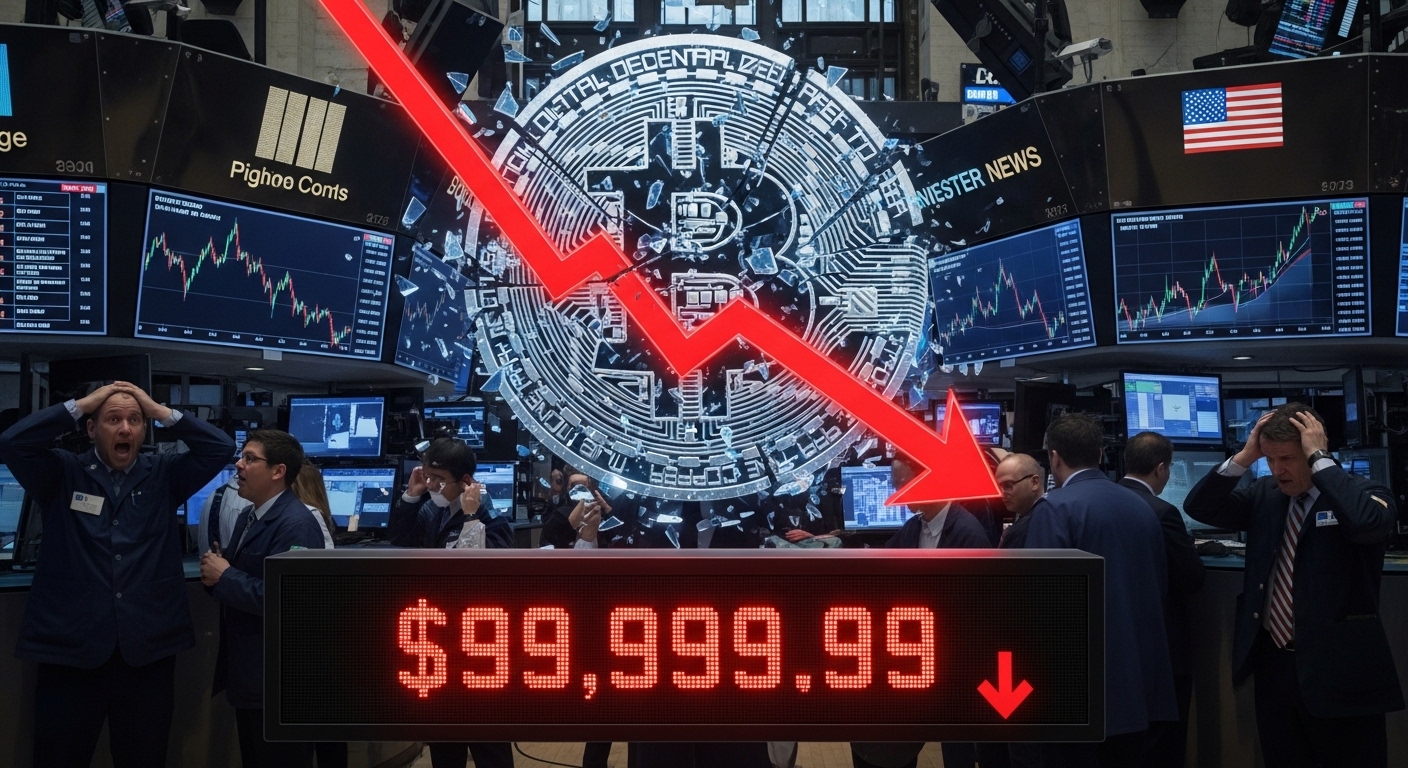
The cryptocurrency market has been shaken once again as Bitcoin falls below $100,000 for the first time since late June. This significant drop has triggered widespread concern among investors, traders, and analysts who had grown increasingly confident in the digital asset’s upward momentum. The sudden decline highlights the unpredictable nature of crypto markets and raises important questions about what lies ahead for the world’s largest cryptocurrency, Bitcoin.
While Bitcoin has experienced volatility throughout its history, falling below such a major psychological and technical level signals a shift in market sentiment. As investors digest the implications, discussions around Bitcoin price drop, crypto market volatility, and Bitcoin future outlook are dominating the financial landscape.
Bitcoin Falls Below $100,000: What Triggered the Drop?
The moment Bitcoin falls below $100,000, it immediately becomes a headline-grabbing event due to the symbolic importance of this price level. Several factors contributed to this downturn, creating a perfect storm of selling pressure.
One of the primary reasons is macroeconomic uncertainty. Rising interest rates and tighter monetary policies by central banks globally have reduced risk appetite. Investors often pull funds out of speculative assets like cryptocurrencies during such periods.
Another contributing factor is profit-taking. After a prolonged rally, many investors decided to lock in gains, leading to increased selling pressure. This behavior is common in highly volatile markets where traders react quickly to price movements.
Additionally, institutional activity has played a role. Large holders, sometimes referred to as “whales,” can influence price movements significantly. When these entities sell substantial amounts of Bitcoin, it can trigger cascading effects across the market.
As a result, Bitcoin falls below $100,000 not just due to one reason, but a combination of economic, technical, and psychological factors.
Psychological Impact of Bitcoin’s Drop
The phrase Bitcoin falls below $100,000 carries more than just numerical significance—it represents a psychological turning point for investors.
Round numbers like $100,000 often act as support or resistance levels. When prices fall below such thresholds, it can trigger panic selling among retail investors. Fear-driven decisions tend to accelerate downward momentum, further intensifying market volatility.
Moreover, media coverage amplifies the situation. Headlines emphasizing the decline contribute to negative sentiment, even among those who might otherwise hold their positions. This creates a feedback loop where fear drives selling, and selling drives further price drops.
On the other hand, seasoned investors often view such dips as buying opportunities. For them, the fact that Bitcoin falls below $100,000 may signal undervaluation rather than weakness.
Historical Context: Has Bitcoin Been Here Before?
To understand the current situation, it’s important to look at Bitcoin’s historical behavior. The cryptocurrency has experienced multiple boom-and-bust cycles since its inception.
There have been numerous instances where Bitcoin reached new highs only to undergo significant corrections. These corrections, while alarming in the short term, have often been followed by recovery and new all-time highs.
For example, previous cycles saw Bitcoin lose substantial value after hitting peak levels, only to regain strength later. This cyclical pattern is one reason why long-term investors remain optimistic.
So while Bitcoin falls below $100,000 may seem alarming, it aligns with the asset’s historical volatility and does not necessarily indicate a long-term decline.
Technical Analysis: Key Levels to Watch
When Bitcoin falls below $100,000, technical analysts begin examining support and resistance levels to predict future movements.
Support levels are price points where buying interest is strong enough to prevent further decline. If Bitcoin stabilizes at a lower support level, it could indicate consolidation before a potential rebound.
Resistance levels, on the other hand, represent price points where selling pressure increases. If Bitcoin attempts to climb back above $100,000, it may face resistance near that level.
Indicators such as moving averages, Relative Strength Index (RSI), and trading volume provide additional insights. A drop below key moving averages can signal bearish trends, while oversold RSI levels might indicate a possible reversal.
In this context, the fact that Bitcoin falls below $100,000 becomes a critical signal for traders analyzing market direction.
Market Reactions as Bitcoin Falls Below $100,000
The broader cryptocurrency market often reacts strongly when Bitcoin experiences significant price movements. As the leading digital asset, Bitcoin influences the performance of altcoins and overall market sentiment.
When Bitcoin falls below $100,000, many altcoins follow suit, experiencing similar or even larger percentage declines. This phenomenon is due to the interconnected nature of crypto markets, where Bitcoin acts as a benchmark.
Investors also tend to shift towards stablecoins or fiat currencies during downturns. This movement reflects a desire to minimize risk and preserve capital in uncertain conditions.
Furthermore, trading volumes typically spike during such events. Increased activity indicates heightened interest and participation, even as prices decline.
Institutional Investors and Bitcoin’s Price Movement
Institutional involvement has been a major driver of Bitcoin’s growth in recent years. Hedge funds, corporations, and asset managers have allocated significant resources to cryptocurrencies.
However, institutional investors also contribute to volatility. When large entities adjust their portfolios, the impact can be substantial.
The moment Bitcoin falls below $100,000, institutional strategies come into focus. Some institutions may reduce exposure to mitigate risk, while others may increase holdings to capitalize on lower prices.
This dual behavior creates a dynamic market environment where price movements are influenced by both retail and institutional actions.
Regulatory Concerns and Their Impact
Regulation remains a key factor influencing cryptocurrency markets. Governments and financial authorities worldwide continue to develop policies aimed at managing digital assets.
Uncertainty around regulations can lead to market instability. Announcements of stricter rules or enforcement actions often trigger sell-offs.
As Bitcoin falls below $100,000, regulatory concerns resurface. Investors worry about potential restrictions that could affect trading, taxation, or adoption.
At the same time, clearer regulations could benefit the market in the long run by providing legitimacy and attracting institutional participation.
Is This a Buying Opportunity or a Warning Sign?
One of the biggest debates among investors is whether the current situation represents an opportunity or a risk.
When Bitcoin falls below $100,000, some see it as a chance to buy at a lower price. This perspective is based on the belief that Bitcoin’s long-term trajectory remains upward.
Others, however, view the decline as a warning sign of deeper issues. Concerns about market saturation, regulatory challenges, and macroeconomic conditions contribute to this cautious outlook.
Ultimately, the decision depends on individual risk tolerance and investment strategy. Both perspectives highlight the complexity of navigating cryptocurrency markets.
Future Outlook: What Happens Next?
Predicting the future of Bitcoin is notoriously difficult due to its volatile nature. However, several scenarios are possible following the event where Bitcoin falls below $100,000.
In a bullish scenario, Bitcoin could stabilize and regain momentum, eventually surpassing previous highs. This outcome would likely require favorable economic conditions and renewed investor confidence.
In a bearish scenario, the price could continue to decline, testing lower support levels. Prolonged uncertainty or negative developments could contribute to this trend.
A neutral scenario involves consolidation, where Bitcoin trades within a range before making a decisive move.
Regardless of the outcome, the current situation underscores the importance of staying informed and adaptable in the rapidly evolving crypto landscape.
Conclusion
The moment Bitcoin falls below the $100,000 mark is a significant event in the cryptocurrency market, reflecting both the opportunities and risks inherent in digital assets. While short-term uncertainty may dominate headlines, long-term perspectives suggest that volatility is part of Bitcoin’s growth journey.
Investors must approach the market with a balanced strategy, combining research, risk management, and patience. Whether this decline is a temporary setback or a sign of broader changes, staying informed is crucial.
If you’re navigating the crypto market, now is the time to closely monitor trends and make informed decisions. Keep tracking updates as Bitcoin falls below $100,000 and position yourself strategically for what comes next.
See more: Bitcoin price today slips to $89.5K on weak demand
