


Crypto markets love a comeback story. Every cycle, traders scan old charts and dream of a repeat: the token that once did a 20x surely “deserves” to revisit its all-time high. But a growing camp of market watchers is pushing back hard on that assumption. Their warning is blunt: altcoins won’t recover previous highs—at least not most of them, and not in the simple, broad “alt season” way investors remember.
This isn’t just negativity. It’s a response to how the market has evolved. The number of tokens has exploded, liquidity is spread across many chains and exchanges, and attention is fractured into short-lived narratives. What once looked like a rising tide lifting everything now looks more like a spotlight that swings quickly and only illuminates a few winners at a time. In this environment, the phrase altcoins won’t recover previous highs becomes less of a dramatic headline and more of a practical framework: many older projects may never reclaim their former peaks, while a smaller set could still thrive—if they earn it.
In this article, we’ll unpack why an analyst might argue that altcoins won’t recover previous highs, what market structure changes are behind the claim, which types of altcoins are most at risk, and how traders and long-term investors can adapt without falling into either blind pessimism or blind hope. You’ll also learn how to think about altcoin season, Bitcoin dominance, tokenomics, and liquidity in a way that fits the market we actually have today—not the market we wish we still had.
Why analysts say altcoins won’t recover previous highs
When an analyst says altcoins won’t recover previous highs, they’re usually making a probability statement about the average altcoin, not a prophecy about every single one. The core idea is that the “basket” of altcoins is much bigger now, and capital is more selective. In earlier cycles, a wave of new money often cascaded from Bitcoin into mid-caps, then into micro-caps, creating a broad melt-up. Today, the same amount of capital has far more places to go, and far more ways to trade without buying long-tail spot tokens.
A second driver is that altcoin rallies face heavier resistance than before. Every cycle leaves behind a layer of holders who bought near the top. When price approaches those levels again, many of those holders sell to escape at break-even. That overhead supply can act like a ceiling, slowing or stopping a move long before the old all-time high. That’s one reason the claim altcoins won’t recover previous highs resonates: it matches what many investors have experienced—sharp bounces that fade as soon as price returns to “pain zones” from prior bubbles.
Finally, market maturity changes behavior. Bigger players often prefer deep liquidity, clean execution, and assets that can handle large orders without extreme slippage. That naturally concentrates activity in fewer coins. Instead of the whole altcoin universe rising together, the market increasingly rewards the top tier and a small group of narrative leaders.
Supply overload: too many tokens chasing too little attention
A major structural change is supply. Token creation has become easy. New coins launch daily across multiple ecosystems. Each new launch competes for the same limited pool of attention and speculative capital. When there were fewer altcoins, it was easier for money to rotate broadly. In a market with endless options, the default outcome is that most assets do not receive sustained inflows.
This is where the analyst warning becomes sharp: altcoins won’t recover previous highs if the market’s growth is dispersed across thousands of new entrants. Even if total crypto market cap grows, the upside may be sliced into thinner pieces. Many older coins end up diluted not by more supply of their own token, but by the sheer number of competing tokens.
Liquidity fragmentation across chains and venues
Liquidity used to be concentrated on a handful of exchanges and a smaller number of dominant narratives. Now, liquidity is scattered across centralized exchanges, decentralized exchanges, multiple layer-1s, layer-2s, and derivative venues. Capital can express a view through perpetual futures, structured products, points programs, liquid staking derivatives, or short-term narrative trades without holding long-tail altcoins.
That fragmentation matters because many altcoins need persistent liquidity to climb. Without steady demand, price can’t push through the overhead supply from previous cycles. So when an analyst says altcoins won’t recover previous highs, they’re often pointing to a simple reality: many coins no longer have the depth or sustained demand required to rebuild an old peak.
The “bagholder ceiling” that keeps altcoins below old highs
One of the most underrated forces in altcoin pricing is psychology. A token that once peaked at a huge valuation created a large population of holders who bought late. After a long bear market, many of them are waiting for one thing: a chance to exit.
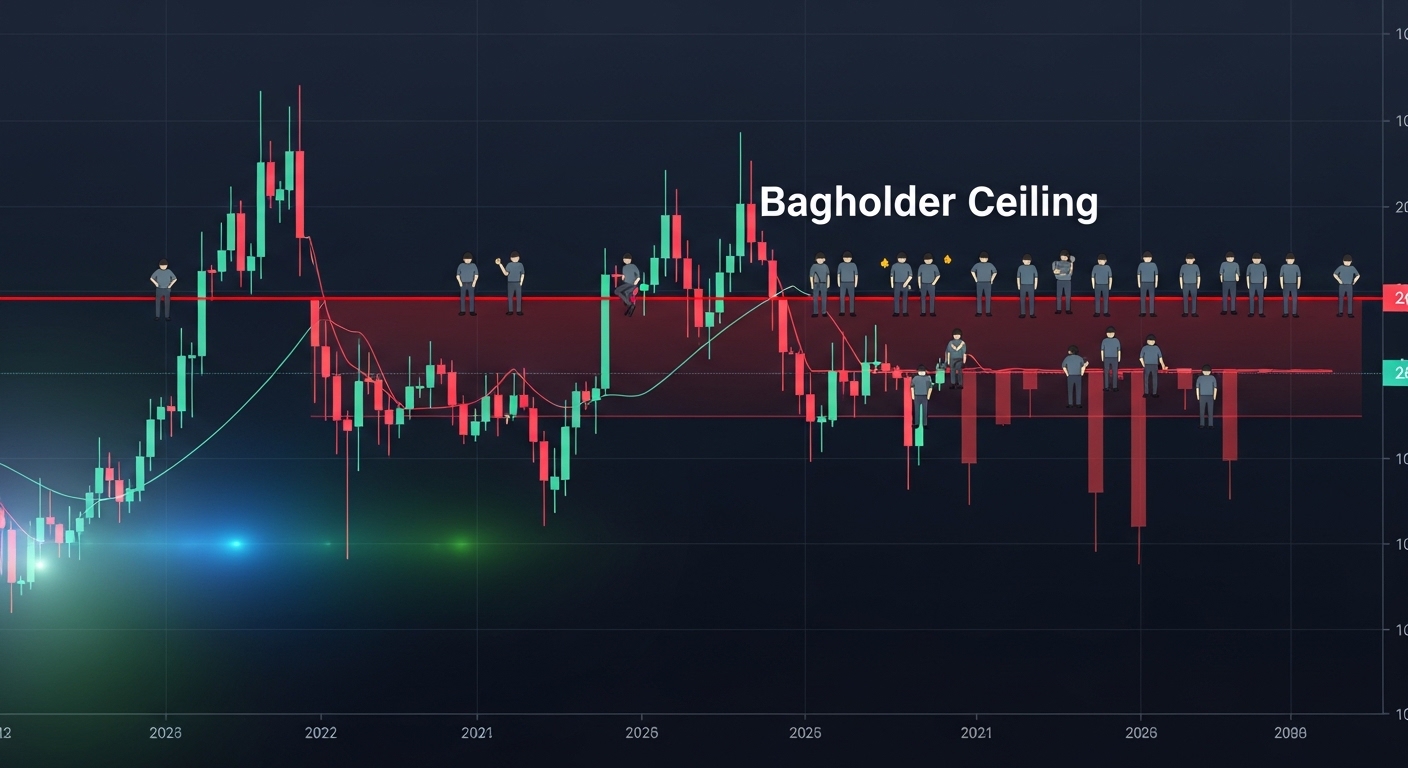
When price rises, those holders often sell into rallies. This creates an invisible wall of sell pressure. The closer price gets to the previous top, the more selling appears. That is why the statement altcoins won’t recover previous highs is believable to many traders: they’ve watched multiple “recovery rallies” die at the same levels.
This dynamic can persist for years. Even a good project can struggle if the token’s ownership distribution is heavy with trapped holders. And for weaker projects, the bagholder ceiling can become permanent because there isn’t enough new demand to absorb that selling.
Why old narratives rarely regain their old magic
Narratives drive altcoins. In one cycle it might be smart contracts, in another NFTs, in another gaming, AI, or modular scaling. The challenge is that narratives evolve. A project that was an early leader can become an “old story,” even if it still exists.
When attention moves on, capital moves on too. The market does not reward nostalgia; it rewards momentum, adoption, and relevance. So the analyst view that altcoins won’t recover previous highs often reflects a harsh truth: some coins were cycle-specific trades, not durable assets.
Bitcoin dominance and why “alt season” may look different
For years, traders have watched Bitcoin dominance as a proxy for altcoin conditions. When dominance falls, altcoins often outperform. When dominance rises, Bitcoin tends to lead and altcoins lag.
But the market has changed. Even if Bitcoin dominance dips, that doesn’t guarantee a broad altcoin boom. The beneficiaries may be concentrated in the most liquid, most visible coins rather than the entire altcoin market. Instead of “everything pumps,” it can become “a few leaders pump.”
That’s another way to interpret the headline altcoins won’t recover previous highs: it doesn’t mean altcoins can’t rise, it means the rise may be narrower, more selective, and less forgiving to weak projects.
The cycle isn’t dead, but it’s not the whole story
The classic four-year rhythm still influences sentiment. People still talk about halving cycles, post-halving expansions, and late-cycle speculation. Yet even if the cycle continues, the distribution of returns can change. A maturing market can keep the broad direction while altering who benefits. So when you hear altcoins won’t recover previous highs, think of it as a warning against assuming the cycle will automatically carry every bag back to glory.
Which altcoins are most likely to never reclaim previous highs
Not all altcoins share the same odds. The analyst argument that altcoins won’t recover previous highs applies most strongly to certain categories. Legacy infrastructure tokens that never captured meaningful users are a common example. If a chain or platform failed to build durable network effects, its token may struggle to justify a return to old valuations. The market is crowded with faster, cheaper, more developer-friendly options, and switching costs can be low.
Tokens with weak value capture are also vulnerable. If the network generates activity but the token doesn’t benefit, the token may rely on hype rather than fundamentals. In a more selective environment, hype is shorter-lived. Coins with aggressive inflation are another risk group. Heavy emissions create constant sell pressure. To reach previous highs, they may need extraordinary demand growth—often unrealistic. That is why many analysts say altcoins won’t recover previous highs when tokenomics are structurally against long-term price appreciation.
Tokenomics: the hidden reason recoveries fail
Tokenomics matters more than most people admit. The supply schedule, unlocks, emissions, and treasury behavior can either support a sustainable market or silently sabotage it. A token that pumped in a low-supply phase may struggle once significant unlocks arrive. If a project has large allocations, frequent unlocks, or a high inflation rate, it can keep price suppressed even during bullish conditions. In that case, the statement altcoins won’t recover previous highs isn’t emotional—it’s mathematical.
The case for selective recovery: some altcoins can still win
Even if altcoins won’t recover previous highs broadly, a smaller group can still outperform dramatically. The market doesn’t stop rewarding innovation; it just rewards it more selectively. Altcoins with strong fundamentals may still have a path to new highs, especially if they show real adoption. That includes consistent user growth, measurable on-chain activity, fee generation, and developer momentum.
If the token captures value—through fees, staking demand, or other mechanisms—it can justify higher valuations without relying purely on narrative. In a modern market, the best altcoins often behave like product companies rather than hype vehicles. They can survive multiple cycles because they keep building, shipping, and attracting users even when headlines fade.
How to spot durability in a noisy market
A practical approach is to ask whether the project has a real reason to exist that hasn’t been commoditized. Does it solve a problem better than alternatives? Does it have network effects? Does it integrate with the broader ecosystem in a way that creates sticky demand? Durable altcoins tend to have deeper liquidity and more consistent attention. They may not be the loudest, but they tend to keep showing up in developer conversations, integrations, and long-term roadmaps.
What “altcoins won’t recover previous highs” really means for investors
For many holders, this phrase triggers fear. But it can also be useful clarity. First, it suggests that “buy and pray” is not a strategy. If you hold an altcoin that has no clear traction, no unique edge, and no credible path to renewed relevance, the market may not reward patience. In that case, altcoins won’t recover previous highs becomes a reminder to reassess rather than wait indefinitely.
Second, it encourages a shift from nostalgia to opportunity cost. Time matters. Capital tied up in stagnant coins misses compounding elsewhere. Even a modest performer can outperform a dead bag if it keeps trend and liquidity. Third, it pushes investors to separate trading from investing. Some altcoins are great trades—volatile, narrative-driven, explosive—but poor long-term holds. Others may be slower but more durable. If you mix those categories without intention, you end up confused and disappointed.
The role of liquidity and exit planning
Liquidity is a survival trait. Coins with thin liquidity can rise fast, but they can also trap you when sentiment flips. A modern approach is to care not only about upside but about how you would exit. If an asset can’t absorb selling without collapsing, it is more likely to validate the claim that altcoins won’t recover previous highs for the average participant. In other words, you don’t just want an asset that can pump—you want one that can sustain.
Common misconceptions that keep people stuck in old-cycle thinking
A common myth is that if Bitcoin reaches new highs, altcoins must follow to new highs too. Correlation is not destiny. Bitcoin can lead while many altcoins lag, especially if capital stays concentrated. Another myth is that a coin is “cheap” because it’s down 90%. Down 90% can be a warning, not an invitation. Many coins are down because demand disappeared or because supply expanded.
Price alone doesn’t tell you value. A third myth is that community guarantees recovery. Community helps, but durable value usually requires builders, users, and a reason for new capital to choose that token over thousands of alternatives. These misconceptions are exactly why an analyst might repeat that altcoins won’t recover previous highs—to break the spell of outdated assumptions.
Conclusion
The analyst warning that altcoins won’t recover previous highs reflects a market that has grown up. There are far more tokens, far more narratives, and far more ways for capital to trade without supporting the long tail. Liquidity is fragmented, attention is scarce, and overhead supply from previous cycle buyers creates powerful resistance. As a result, the average altcoin faces an uphill battle to reclaim its former peak.
Still, this isn’t a death sentence for altcoins. It’s a filter. The market is increasingly selective, and selective markets can still create massive winners. The key is adapting: focusing on strong fundamentals, better tokenomics, real adoption, and liquidity, while letting go of the assumption that every old chart will repeat. In a world where altcoins won’t recover previous highs for most projects, the edge comes from choosing quality, managing risk, and staying flexible as narratives evolve.
FAQs
Q: Does “altcoins won’t recover previous highs” mean no altcoin will ever hit a new all-time high?
No. It usually means most altcoins won’t revisit their prior peaks, while a smaller set with strong adoption, liquidity, and value capture can still reach new highs.
Q: Why do some altcoins struggle to recover even in bullish markets?
Many face a “bagholder ceiling,” where prior-cycle buyers sell into rallies near break-even. Others suffer from weak tokenomics, inflation, or lost relevance as narratives change.
Q: Is altcoin season still possible?
A form of altcoin season is still possible, but it may be narrower and more selective. Instead of a broad market lift, leadership may concentrate in fewer, higher-quality assets.
Q: What should I look for in altcoins that might recover or outperform?
Focus on real user growth, consistent on-chain activity, sustainable tokenomics, strong integrations, and deep liquidity. Also consider whether the token actually captures value from the network.
Q: Should I avoid altcoins entirely if altcoins won’t recover previous highs?
Not necessarily. The better takeaway is to be selective and risk-aware. Many altcoins may underperform, but the right projects and narratives can still offer strong opportunities if you manage liquidity and timing.
Also More: Altcoins Facing Major Liquidation Risks in Early February
