

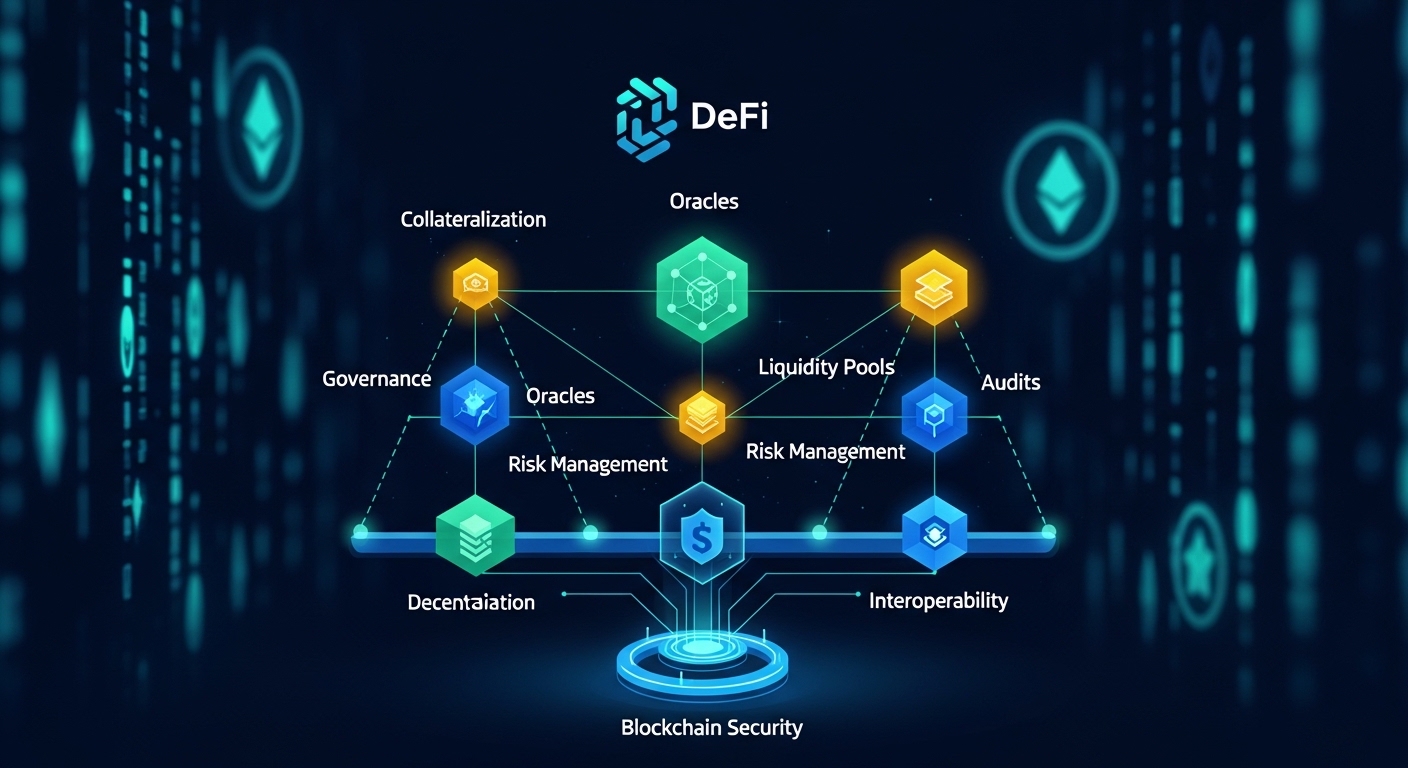
Decentralized finance has evolved from a fringe experiment into a multi-billion-dollar financial ecosystem in less than a decade. By replacing intermediaries with smart contracts, DeFi promised efficiency, transparency, and global access. Yet as the sector matured, it also exposed structural weaknesses: fragile liquidity, governance capture, protocol failures, and incentive systems that reward short-term speculation over long-term sustainability. These growing pains have pushed the industry to re-examine an unlikely source of guidance—traditional finance.
While DeFi was initially positioned as an alternative to legacy systems, its next phase depends on selectively adopting traditional finance principles that promote resilience, accountability, and trust. This shift does not represent ideological surrender. Instead, it reflects a natural maturation process similar to what early internet companies experienced when they moved from experimentation to infrastructure.
Adding depth to this discussion is Vitalik Buterin’s powerful endorsement of Zcash, which reignited debates around governance, privacy, and long-term blockchain values. His comments in 2025 highlighted the risks of token-weighted governance and praised alternative models that protect foundational principles rather than short-term market incentives. Together, these developments signal a pivotal moment for DeFi, where lessons from traditional finance and privacy-focused blockchain design may define the industry’s future.
DeFi’s Growth Has Outpaced Its Stability
The explosive expansion of decentralized finance was driven by innovation speed. Protocols launched rapidly, composability allowed capital to move freely, and incentives attracted massive liquidity in record time. However, growth without structural discipline created systemic vulnerabilities. Market downturns revealed how quickly liquidity could evaporate, how governance votes could be manipulated, and how interconnected protocols could amplify failure.
Traditional financial systems evolved under similar pressures but developed safeguards over decades. Risk committees, capital buffers, stress testing, and compliance frameworks were not designed to stifle innovation but to ensure continuity. DeFi now faces the same crossroads. Without integrating traditional finance principles, decentralized systems risk repeating failures that legacy finance already learned to mitigate.

This realization is pushing DeFi toward a more measured approach—one that values durability alongside innovation. Stability is becoming a competitive advantage rather than a constraint.
Why Traditional Finance Principles Matter in a Decentralized World
The phrase “traditional finance principles” often carries negative connotations in crypto circles, but the reality is more nuanced. These principles are not inherently centralized; they are methodologies for managing complexity and uncertainty.
Risk Management as Core Infrastructure
In traditional finance, risk management is not optional. Every financial product is evaluated against credit risk, liquidity risk, operational risk, and systemic exposure. DeFi protocols, by contrast, often rely on overcollateralization as a blanket solution. While effective in theory, this approach can fail during extreme volatility or correlated market events.
By embedding risk modeling, scenario analysis, and conservative assumptions directly into smart contracts, DeFi can become more resilient. Protocols that treat risk management as infrastructure rather than an afterthought are better positioned to survive market stress and maintain user trust.
Liquidity Discipline Over Illusory Depth
Liquidity in DeFi can appear abundant during bull markets, yet vanish rapidly during downturns. Automated market makers and lending pools rely on incentives that may not hold under pressure. Traditional finance addresses this issue by evaluating liquidity under stress scenarios, not just during normal conditions.
Applying traditional finance principles to DeFi liquidity means designing systems that account for worst-case behavior. Dynamic parameters, volatility-aware mechanisms, and automated safeguards can prevent cascading failures and reduce the severity of market shocks.
Governance as a Stability Mechanism
Governance is one of DeFi’s most powerful tools—and one of its greatest risks. Token-based voting systems often equate wealth with influence, creating incentives for governance capture and short-term decision-making. This structure can undermine protocol safety, particularly when critical parameters are adjusted to chase yield or market hype.
Here, traditional governance concepts such as separation of powers, accountability, and long-term stewardship become highly relevant. Decentralization does not require the absence of structure; it requires thoughtful design that aligns incentives with the protocol’s mission.
Vitalik Buterin’s Zcash Endorsement and Its Deeper Meaning
In 2025, Vitalik Buterin’s comments on Zcash resonated far beyond the privacy-coin community. His praise centered on Zcash’s commitment to long-term values and its resistance to purely token-weighted governance models. He cautioned that token voting, while simple and popular, can gradually erode foundational principles such as privacy when financial incentives dominate decision-making.
This perspective offered a powerful parallel for DeFi. Just as privacy can be weakened by governance capture, so too can protocol safety, fairness, and decentralization. Buterin’s endorsement of alternative governance experimentation signaled a broader truth: governance design is not neutral. It shapes outcomes over time.
Zcash’s willingness to explore off-chain governance structures demonstrated that blockchain projects do not need to be rigid in their approach. Flexibility, experimentation, and mission alignment are essential for longevity. These lessons translate directly into DeFi, where governance failures often precede financial collapses.
Aligning Traditional Finance Principles With DeFi Values
The challenge for DeFi is not whether to adopt traditional finance principles, but how to do so without compromising decentralization and openness.
Transparency Without Sacrificing Privacy
Transparency is a defining feature of DeFi, enabling users to verify protocol behavior in real time. However, complete transparency can conflict with user privacy and institutional participation. Privacy-focused blockchains like Zcash highlight the importance of protecting sensitive information while preserving trust.
The future lies in selective transparency, where systems prove correctness without revealing unnecessary data. Cryptographic tools allow DeFi protocols to demonstrate solvency, compliance, and risk exposure while safeguarding user privacy. This balance mirrors traditional finance practices, where disclosure is controlled rather than absolute.
Institutional Participation Through Predictability
Institutions are often portrayed as antithetical to decentralization, yet their primary requirement is predictability, not control. Clear rules, stable governance, and consistent risk management make participation feasible. By adopting traditional finance principles, DeFi protocols can attract long-term capital without surrendering autonomy.
This shift supports ecosystem maturity. When capital is patient and governance is disciplined, innovation can proceed without destabilizing the entire system.
Practical Applications of Traditional Finance Principles in DeFi

DeFi’s evolution does not require sweeping reforms. Incremental changes can significantly improve stability.
Smart Contract Guardrails
Time delays on upgrades, parameter limits, and emergency controls reduce the risk of catastrophic errors. These mechanisms function like internal controls in traditional finance, ensuring that no single action can jeopardize the system.
Sustainable Incentive Design
Traditional finance emphasizes long-term performance metrics. DeFi can adopt similar thinking by rewarding behaviors that support protocol health rather than short-term liquidity spikes. Incentives aligned with durability encourage users to act as stakeholders, not mercenaries.
Governance Beyond Token Weight
Inspired by debates around Zcash, DeFi can explore hybrid governance models that combine token voting with reputation, expertise, or contribution-based influence. Such systems reduce the likelihood of governance capture and preserve the protocol’s mission over time.
2025 Blockchain Implications for DeFi and Beyond
The convergence of DeFi maturation and renewed focus on governance and privacy marks a defining moment for blockchain technology. Vitalik Buterin’s Zcash praise underscored the importance of protecting long-term values even when short-term incentives push in the opposite direction.
For DeFi, this means shifting priorities. Growth remains important, but not at the expense of resilience. Protocols that integrate traditional finance principles into their design are more likely to survive regulatory scrutiny, market volatility, and user expectations.
This evolution also positions blockchain as a credible alternative financial infrastructure rather than a speculative playground. Stability, privacy, and decentralization can coexist—but only through intentional design.
Conclusion
DeFi’s next chapter will not be defined by how fast it grows, but by how well it endures. By adopting traditional finance principles such as disciplined risk management, liquidity realism, and robust governance, decentralized finance can achieve the stability required for long-term relevance. Vitalik Buterin’s endorsement of Zcash and his warnings about token-weighted governance highlight the broader challenge facing blockchain systems: protecting foundational values against short-term pressures.
If DeFi learns from both traditional finance and privacy-focused blockchain governance, it can mature without losing its revolutionary spirit. The result is a financial ecosystem that is open, resilient, and worthy of global trust.
FAQs
Q: Why are traditional finance principles important for DeFi’s future?
They provide tested frameworks for managing risk, governance, and liquidity, helping DeFi systems survive volatility and scale responsibly.
Q: Does adopting traditional finance principles mean centralizing DeFi?
No. These principles can be implemented through decentralized code, transparent governance, and automated controls without centralized authority.
Q: What did Vitalik Buterin’s Zcash praise reveal about governance?
It highlighted the dangers of purely token-weighted voting and emphasized the need for governance models that protect long-term values like privacy and protocol integrity.
Q: How can DeFi balance transparency and privacy?
Through cryptographic techniques that allow systems to prove correctness and solvency without exposing sensitive user data.
Q: What will define successful DeFi protocols after 2025?
Protocols that combine innovation with stability, adopt traditional finance principles, and design governance systems that align incentives with long-term sustainability.
