


Solana has a way of defying expectations. Just when market sentiment turns cautious and the SOL chart looks weak, the on-chain story can point in the opposite direction. Lately, that disconnect has become more noticeable: Solana network activity is rising even while SOL’s token price has slipped. For anyone tracking the ecosystem, this divergence raises an important question: how can the network look busier than ever when the asset tied to it is trending downward?
The simplest explanation is that token price and network usage don’t always move together in the short term. Prices are shaped by macro liquidity, risk appetite, narrative cycles, and capital rotation across the market. Network usage, however, is shaped by real demand for block space: people trading, bridging, minting, gaming, using payments, interacting with DeFi, and exploring new apps. When usage remains strong during a pullback, it can imply the chain has developed genuine utility beyond speculation.
This is why the headline matters: Solana network sees rising activity despite token price drop. It suggests the ecosystem may be expanding its user base, transaction throughput, and application engagement even if traders aren’t rewarding SOL’s price right now. That doesn’t automatically guarantee a bullish outcome, but it does indicate that Solana’s fundamentals deserve attention.
In the sections below, we’ll explore what “rising activity” really means, why SOL can fall while the network grows, which on-chain indicators to watch, and how to interpret the trend without getting trapped in hype. Along the way, we’ll naturally include related terms like on-chain data, daily active addresses, transaction volume, network fees, DEX volume, stablecoins, and Solana DeFi to paint a complete picture.
Why Solana Activity Can Rise While SOL Price Falls
It’s tempting to assume that a busy blockchain must have a rising token price, but crypto markets don’t work that cleanly. Even when the Solana network is processing more transactions and attracting more users, SOL can fall for reasons that have little to do with network health.
One major factor is broader market structure. When liquidity tightens or the market turns risk-off, altcoins often suffer more than major assets. Investors may reduce exposure across the board, and SOL can decline even if the ecosystem remains active. Another factor is capital rotation. Traders frequently move from one narrative to another—AI tokens, Layer 2 themes, meme cycles, or Bitcoin dominance periods—leaving SOL temporarily underbid.
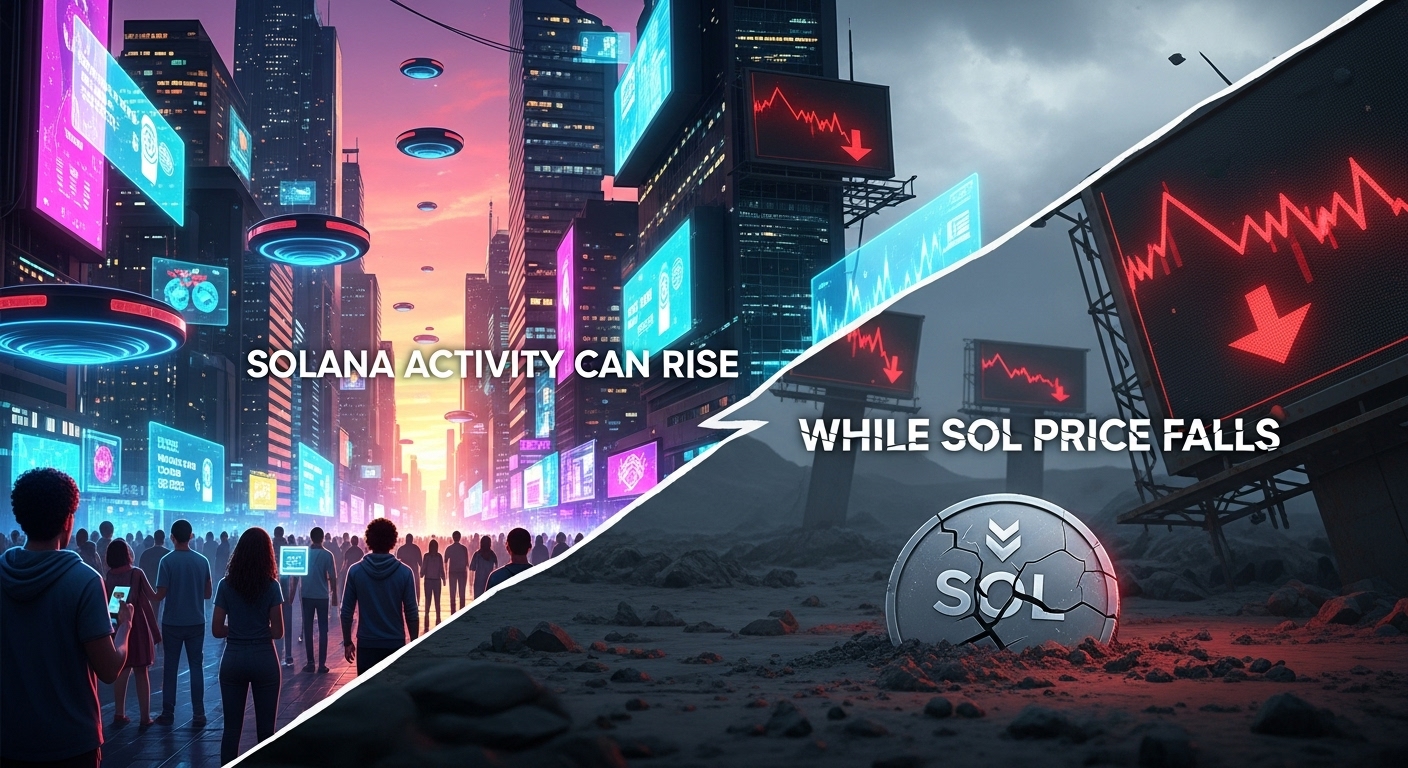
At the same time, rising Solana network activity can be driven by practical reasons. Solana’s fast execution and typically low costs encourage frequent usage. People trade more often, apps can support micro-interactions, and high-frequency strategies become feasible. That creates an environment where usage can stay strong even when price sentiment is weak.
Utility and valuation don’t always align
In traditional markets, companies can have strong product usage while their stock falls due to macro pressure or sentiment. Crypto is similar, but the swings are amplified. Solana may be experiencing a utility expansion phase while the market remains focused on short-term price action. That’s how you end up with the pattern we’re examining: Solana network sees rising activity despite token price drop.
Low fees can amplify transaction behavior
Solana’s low fees and fast confirmations can lead to higher transaction frequency. This doesn’t automatically mean adoption is exploding, but it does mean user behavior changes. A trader on a higher-fee chain might swap once or twice; on Solana, they might swap ten times in the same period. A game or consumer app can execute more on-chain actions without punishing the user. Over time, this can drive higher transaction volume and greater engagement even in a bearish price environment.
The On-Chain Metrics Behind Rising Solana Network Activity
When people say the Solana network is more active, they’re usually talking about several measurable trends. To understand whether growth is meaningful, it’s important to look at a group of signals rather than one headline number.
Transaction volume and throughput trends
One of the most visible indicators is total transactions. Solana is built for high throughput, so its raw transaction numbers can look massive compared to slower chains. The key is not just the headline count, but whether usage stays elevated consistently. If transaction volume rises steadily while SOL falls, that can suggest the ecosystem is being used for more than speculative “buy and hold.”
Daily active addresses and user participation
Another major metric is daily active addresses or unique active wallets. These numbers can hint at user growth and retention. Rising active addresses can reflect new onboarding through consumer apps, payments activity, DeFi adoption, or trading booms.
However, this metric needs context. In crypto, activity can be inflated by bots, farming strategies, or short-lived speculation. That’s why it’s helpful to combine active addresses with other measures like fees, stablecoin flows, and DeFi volume to assess quality.
Network fees and economic output
While Solana fees are generally low per transaction, total fees can still be meaningful if activity is high. Fees are a form of economic output: users are paying for block space. When fees and app revenue rise alongside usage, it suggests demand is real, not just artificial noise. If activity rises but fees remain flat or collapse, it may indicate the usage is low-quality or heavily automated.
What’s Driving the Increase in Solana Network Activity?
To explain why Solana network activity is rising despite a token price decline, we need to look at what users are actually doing on-chain. Solana’s growth tends to be driven by multiple “lanes” at once: DeFi trading, meme speculation, stablecoin movement, NFTs, gaming, and emerging consumer applications.
Solana DeFi and the growth of on-chain trading
Solana has developed a strong trading culture. Many users treat Solana as a high-speed environment for swaps, liquidity strategies, and fast reaction to market moves. When volatility increases—even if SOL’s direction is down—trading activity can rise because people are repositioning, hedging, rotating, or chasing short-term opportunities.
Solana DeFi tends to benefit from this behavior because traders prefer low friction. If the chain offers quick execution and minimal costs, more users are willing to transact frequently. This dynamic can keep DEX activity strong even when the broader market is uncertain.
DEX volume as a core driver
A major part of rising Solana network activity often comes from DEX volume. When decentralized exchanges see higher usage, the network processes more swaps and related transactions. DEX growth can be driven by new token launches, increased volatility, or improved liquidity conditions within Solana’s ecosystem.
Even during a token pullback, DEX volume can rise if users are actively trading SOL pairs, rotating into stablecoins, or moving between ecosystem tokens.
Liquidity behavior and faster rotations
Solana’s structure encourages faster rotations. If it’s easy to enter and exit positions, users do it more frequently. This can cause transaction counts and DEX activity to climb without necessarily lifting SOL’s price. In other words, the same user might contribute significantly more activity simply due to better user experience and lower costs.
Memecoins and speculation: noisy, but powerful
Memecoins have become a major accelerator of activity on many chains, and Solana is no exception. When meme narratives take off, the network can experience dramatic bursts of wallet creation, token swaps, liquidity provisioning, and rapid-fire trading.
This kind of activity is often dismissed as “noise,” but it can still matter. Speculative waves bring new users, push liquidity into the ecosystem, and attract builders who want to capture attention. Some users remain after the hype fades, transitioning into more durable use cases like DeFi, payments, or consumer apps.
Still, it’s important to evaluate memecoin-driven growth carefully. If activity is overwhelmingly speculative and fades quickly, it may not represent long-term adoption. But if speculative onboarding leads to broader ecosystem engagement, it can contribute to sustained growth.
Stablecoins and payment-like activity
Stablecoins are a quieter but more structurally important driver of activity. When stablecoin supply and usage increase, it means more capital is circulating on-chain. Stablecoins also make trading easier, since they provide a consistent unit of account. If users can move stablecoins cheaply and quickly, they can trade, pay, and transfer value without leaving the chain.
In many ecosystems, stablecoins become the “plumbing” that supports everything else—DeFi, swaps, payments, and cross-app flows. Rising stablecoin activity can therefore help explain why the Solana network sees rising activity despite token price drop. Even if SOL declines, stablecoins can keep the economy moving.
Why SOL Can Keep Dropping Even When the Network Looks Strong
So, if Solana is busy, why isn’t SOL rising? There are several reasonable explanations.
First, token price often reflects market-wide liquidity more than app-level success. Even strong networks can see their tokens fall if the market is risk-off. Second, traders may be taking profits or reducing leverage after a prior run. Price can also be pressured by supply factors such as unlocks or distribution, depending on the period.
Third, the market sometimes separates the chain’s success from the token’s immediate narrative. Some participants treat SOL like a risk asset that moves with broader conditions, while network usage is seen as a slower-moving fundamental signal. This creates the mismatch: usage rises now, price reacts later—or doesn’t react if other forces dominate.
Valuation can outrun fundamentals
Another possibility is that SOL’s valuation previously ran ahead of fundamentals, and the market is still digesting that move. In those cases, even rising Solana network activity might not immediately lift the price. The network can be strong while the market “resets” expectations.
Is Rising Solana Network Activity Actually Bullish?
Rising activity is generally a positive sign, but it depends on quality. The most bullish version of this story is that Solana is onboarding real users into sticky applications, building deep liquidity, and expanding stablecoin-driven economic activity. In that scenario, the network’s growth could eventually influence market perception and token valuation.
The less bullish version is that activity is mainly driven by short-lived speculation, bots, or farming behavior. That can inflate numbers temporarily without creating lasting demand. The truth is often somewhere in the middle: speculation drives attention, while a portion of users and capital remains in the ecosystem and becomes long-term adoption.
To interpret the trend, it helps to watch whether multiple indicators are rising together. If daily active addresses, transaction volume, DEX activity, and fee output remain strong across time—not just for a few days—then the case for durable growth is stronger.
The most useful signals to monitor
When the Solana network is active during a price slump, the clearest signals often include consistent usage over weeks, stablecoin circulation, and sustained DeFi liquidity. These are harder to fake for long periods. If those remain elevated, it suggests the ecosystem has real momentum even if price action is lagging.
What This Means for Traders and Long-Term Holders
For traders, rising network activity in a downtrend can signal building pressure for a reversal, but it is not a timing tool. Markets can stay weak longer than expected, and tokens can keep falling even when fundamentals improve. Still, a growing network can improve risk-reward over time, especially when combined with signs of market stabilization.
For long-term holders, the divergence can be more meaningful. If the Solana network sees rising activity despite token price drop, it may suggest adoption is compounding while the market is discounting SOL. Historically, that kind of setup can create attractive long-term entries—though nothing is guaranteed in crypto.
A sensible approach is to treat rising Solana network activity as a constructive fundamental indicator while respecting broader market risk and portfolio sizing. Fundamentals can improve while price remains volatile, and patience often matters more than predicting the exact turning point.
Conclusion
The headline captures a real market tension: Solana network sees rising activity despite token price drop. While SOL’s price can be weighed down by macro conditions, sentiment cycles, and capital rotation, the network’s usage can tell a different story—one of expanding on-chain engagement, strong trading flows, and an ecosystem that continues to attract users.
Rising Solana network activity doesn’t automatically guarantee a price rebound, and not all activity is equally meaningful. But when growth shows up across multiple signals—transactions, daily active addresses, DEX volume, stablecoin movement, and fee output—it becomes harder to dismiss as noise. Ultimately, the market may not reward fundamentals immediately, but a blockchain that remains busy during downtrends is often building the foundation for its next phase of expansion.
FAQs
Q: Why does the Solana network see rising activity despite token price drop?
Because network usage depends on apps, fees, and user behavior, while token price depends on market liquidity, sentiment, and capital rotation. These forces can diverge for long periods.
Q: Does higher Solana network activity guarantee SOL will go up?
No. Rising Solana network activity can be bullish, but SOL’s price can still fall due to macro pressure, leverage unwinds, or shifting narratives across the market.
Q: What are the best indicators of Solana network activity?
Common indicators include transaction volume, daily active addresses, DEX volume, stablecoin transfers, and total fee output. Watching several together gives a clearer picture.
Q: Can bots or memecoins inflate Solana activity?
Yes. Memecoin booms and automated trading can increase transactions and active addresses. That’s why it’s important to compare activity with fee output, stablecoin flows, and longer-term consistency.
Q: Is rising Solana network activity good for the ecosystem even if SOL price is down?
Often, yes. Higher activity can improve liquidity, attract developers, grow app usage, and strengthen the chain’s real economy. Over time, durable adoption can influence market perception—though timing varies.
See More: Whale Accumulation & Solana Why It Moves Altcoins
