


Ethereum triangle breakout has a way of lighting up traders’ imaginations because it combines two things markets love: compression and release. Triangles form when volatility tightens, price swings narrow, and buyers and sellers negotiate in an ever-smaller range. Eventually, that tension resolves. In breakout-focused strategies, the resolution is the moment the market reveals who had the stronger hand—demand that absorbs supply, or supply that overwhelms demand.
In this scenario, the story is bold: an Ethereum triangle breakout that puts ETH price above $24,000 and maps a path higher through key technical zones. Whether you’re an investor trying to understand what a breakout implies or a trader evaluating risk, the appeal is the same. A triangle structure suggests the market has been building energy, and the breakout offers a framework to define levels, invalidation points, and potential targets.
Still, it’s important to keep both feet on the ground. A breakout is not a guarantee of a sustained rally, and crypto markets are famous for false moves. The goal isn’t to “predict” with certainty; it’s to use the Ethereum triangle breakout concept to create a logical roadmap: what must hold for ETH to remain bullish, where the market might retest, how momentum could build, and what would invalidate the thesis. Along the way, we’ll incorporate technical analysis insights, price action context, and market sentiment considerations, so the overall picture feels coherent rather than hype-driven.
By the end, you’ll have a practical path narrative—how a triangle breakout can translate into steps, levels, and behavior that support the idea of ETH sustaining strength above $24,000, and what to watch if the market tries to shake out late buyers.
Understanding the Ethereum triangle breakout setup
An Ethereum triangle breakout typically refers to ETH consolidating within converging trendlines, where highs get lower and lows get higher (symmetrical triangle), or where one side is flatter (ascending or descending triangle). Regardless of the type, the market is compressing. That compression often indicates indecision, but it can also represent accumulation beneath resistance or distribution above support.
In clean triangle structures, the crowd begins to agree on boundaries. Sellers defend an upper line, buyers defend a lower line, and each attempt to push price is met with a counterforce. The pattern continues until one side runs out of ammunition. Breakouts occur when price closes decisively beyond the trendline and follow-through buying confirms the move.
From a practical standpoint, the Ethereum triangle breakout thesis becomes stronger when the breakout is accompanied by expanding volume, improving momentum indicators, and a broader risk-on environment. Traders often look for a combination of a strong candle close beyond resistance, a retest of the broken trendline as support, and then continuation. That “break, retest, run” sequence is one of the most watched behaviors in crypto technical analysis, because it helps differentiate a real shift in market control from a temporary spike.
Why triangles are powerful in crypto price action
Crypto markets move fast, and volatility can make patterns unreliable. Yet triangles remain popular because they provide clear structure. In an environment where narratives change quickly, a triangle gives traders something objective: boundaries, compression, and a potential trigger point. When ETH is coiling, it often means liquidity is building on both sides, and a breakout can cause cascading effects as stop-losses trigger and breakout orders activate.
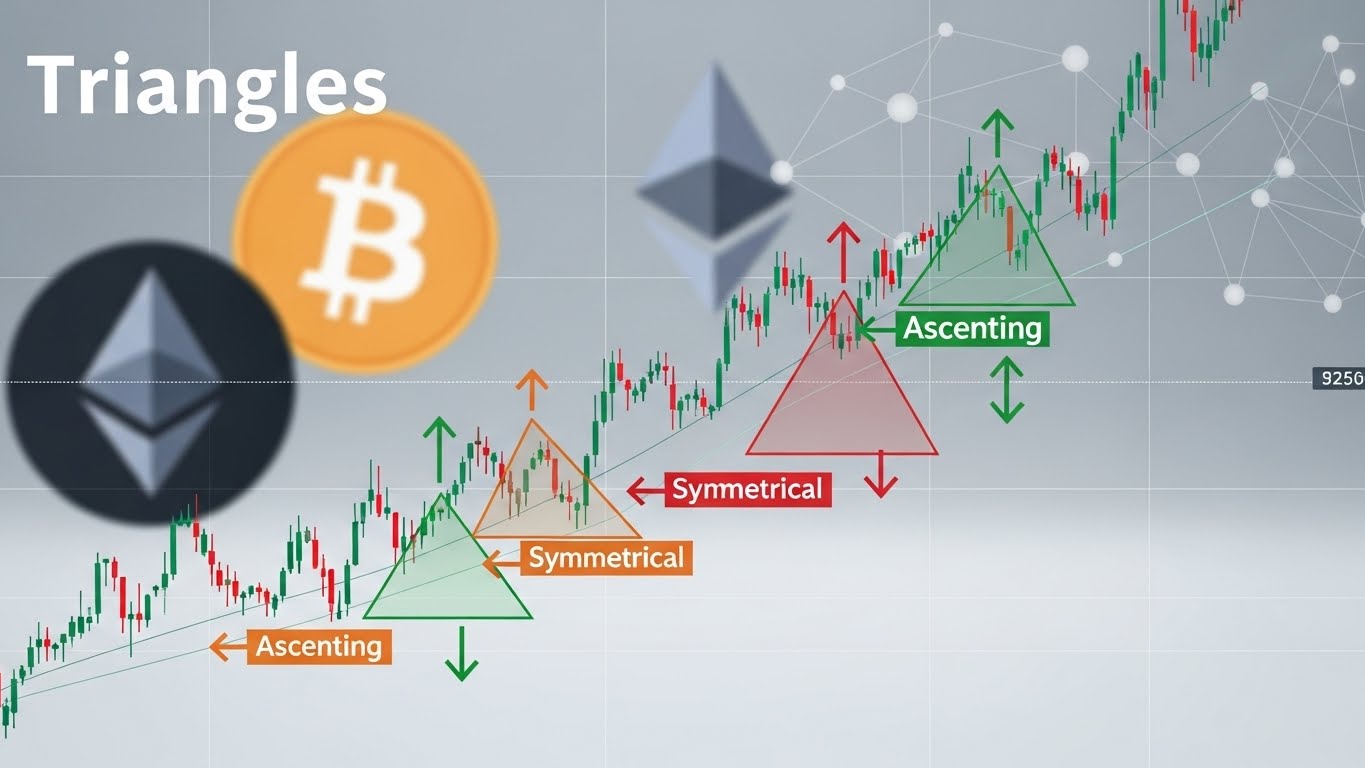
In other words, an Ethereum triangle breakout is not only about direction; it’s also about liquidity mechanics. If price pushes up and clears resistance, short positions may cover, sidelined buyers may chase, and algorithms may switch regimes. That cluster of reactions can produce the sharp “expansion phase” that often follows a prolonged consolidation.
$24,000 headline and what it represents conceptually
Let’s address the obvious: ETH at $24,000 is not a small move from typical ranges traders are used to. But in an article like this, the number functions as a symbolic milestone—the idea of a breakout-driven trend that resets expectations. The point is not to claim a guaranteed destination; it’s to explain how a triangle breakout framework creates a path where higher highs and higher lows stack into a larger move, potentially reaching such a level if conditions remain supportive.
In that sense, “above $24,000” is a narrative anchor. The real value is the roadmap: what steps would need to happen along the way, what zones matter, and what evidence would support the move continuing.
Key confirmation signals for an Ethereum triangle breakout
A breakout without confirmation is just a momentary excursion. The core question is whether the market accepts the new range. Confirmation typically includes multiple elements working together: sustained closes beyond the trendline, successful retests, improving momentum, and strong participation.
One way to think about confirmation is to split it into behavior and structure. Behavior is what price does immediately after breaking out—does it snap back, or does it build a base above the former resistance? Structure is how the market reorganizes—does ETH begin printing higher lows on pullbacks, suggesting buyers are stepping in earlier each time?
Volume expansion and participation strength
Volume is a classic confirmation tool. During consolidation, volume often fades as the range tightens. On a meaningful breakout, volume tends to expand as participants commit. In the context of an Ethereum triangle breakout, a strong push through resistance with rising volume can indicate real demand rather than a thin-liquidity wick.
Participation also shows up in how quickly pullbacks get bought. If ETH breaks out and then barely gives back ground, it suggests that buyers are willing to pay up and defend the new level. That kind of behavior supports the idea of continuation toward higher targets.
Candle closes and reclaim mechanics
In price action trading, candle closes matter more than intraday spikes. A close above the triangle’s upper boundary—especially on higher timeframes—often carries more weight than a brief move that reverses before the close.
Another crucial behavior is reclaim. Sometimes ETH breaks above the triangle, then dips back into the structure. If the market quickly reclaims the breakout line and closes above it again, that can be a powerful signal that sellers attempted to trap breakout buyers but failed. This “failed breakdown” or “reclaim” action is one of the most bullish tells in technical analysis because it suggests supply was absorbed.
Mapping “the path” after the breakout: how ETH can build toward $24,000
A believable path after an Ethereum triangle breakout isn’t one straight candle upward. Trends typically advance in legs and pauses. The most sustainable rallies often include controlled pullbacks that hold key levels and reset funding, sentiment, and momentum before the next leg.
The roadmap concept can be explained in stages: breakout, retest, continuation, consolidation above new support, and then trend acceleration. Each stage has observable characteristics that either validate or weaken the bullish case.
Stage 1 — Breakout and immediate follow-through
The first stage is the breakout itself: ETH clears the triangle resistance and prints follow-through. In this phase, the market is proving that it can trade above the structure without immediately collapsing. Momentum traders enter here, but so do longer-term participants who interpret the breakout as a regime shift.
In a strong Ethereum triangle breakout, pullbacks in this stage are shallow. If sellers regain control quickly, it raises the odds of a false breakout. If buyers keep pressure on, it sets up the next stage: the retest.
Stage 2 — Retest of former resistance as support
The retest is where the breakout becomes “real” in the eyes of many market participants. ETH often returns to the broken trendline or key horizontal resistance near it. The test is simple: do buyers defend it?
When the retest holds, the market is signaling acceptance. It’s also offering a cleaner risk-defined entry for those who didn’t want to chase the initial move. In breakout strategy language, this is where ETH turns a prior ceiling into a floor—a hallmark of trend continuation.
Stage 3 — Continuation leg and new higher high structure
After the retest, continuation is driven by confidence. If ETH prints a fresh higher high and then consolidates without giving it back, the market is building a staircase. This is where the Ethereum triangle breakout transitions into a broader uptrend defined by higher highs and higher lows.
Continuation legs are often fueled by improving market sentiment, positive catalysts, or rising liquidity. It’s also common to see acceleration as the market recognizes the breakout’s significance and positioning shifts from defensive to offensive.
Stage 4 — Consolidation above support and trend durability
Sustained rallies need breathers. Consolidation above newly established support is where the market proves durability. ETH may chop sideways or drift slightly lower, but the key is that it holds critical zones and doesn’t collapse back into the triangle.
This stage often resets leverage. If funding rates had risen during the breakout, consolidation can cool them off. If sentiment became euphoric, sideways action can frustrate late buyers and shake out weak hands. Paradoxically, that can strengthen the trend by transferring supply to stronger holders.
Stage 5 — Expansion toward major psychological targets
If the trend remains intact, the final stage is expansion into bigger targets and psychological milestones. This is where the $24,000 narrative comes in: not as a guaranteed endpoint, but as an example of how a sustained Ethereum triangle breakout can evolve into a multi-leg move.
Expansion phases often include volatility spikes and rapid repricing. Traders watch for signs of exhaustion, such as blow-off candles, weakening momentum, or repeated failures to hold new highs. But until those appear, the trend can continue to surprise.
Technical analysis tools that support the Ethereum triangle breakout thesis

A triangle breakout can be analyzed with multiple tools, but the most useful ones are those that align with price structure rather than distract from it. The goal is to avoid indicator overload and focus on a few that confirm momentum and trend health.
Moving averages and trend alignment
Moving averages are commonly used to define trend direction and dynamic support. In a bullish scenario after an Ethereum triangle breakout, ETH often holds above key moving averages on pullbacks. When multiple averages begin sloping upward and stacking in bullish order, it suggests trend alignment rather than a temporary spike.
The key is not the exact moving average number, but the behavior: does ETH bounce when it approaches these dynamic levels, and does it reclaim quickly when it dips below? That responsiveness can be a clue that buyers are defending the trend.
RSI and momentum confirmation
The Relative Strength Index (RSI) can help identify whether the breakout is supported by real momentum. In sustained uptrends, RSI often stays elevated and does not fully reset to oversold levels during pullbacks. That can indicate persistent demand.
However, RSI is best used as a contextual tool. If ETH makes new highs but RSI fails to confirm, it can hint at waning momentum. If RSI breaks out alongside price, it supports the Ethereum triangle breakout narrative.
Fibonacci zones and measured move logic
Traders often project targets using Fibonacci extensions or a triangle’s measured move (the height of the triangle projected from the breakout point). These tools offer a structured way to think about the path forward.
But projections should be treated as zones, not exact numbers. ETH can overshoot or undershoot targets, especially in crypto. The value is in anticipating where reactions may occur: areas where profit-taking increases, volatility returns, or consolidation forms.
Catalysts that can amplify an Ethereum triangle breakout
Charts matter, but crypto is also narrative-driven. A strong Ethereum triangle breakout often coincides with catalysts that increase interest, improve liquidity, or shift macro sentiment.
Macro liquidity and risk appetite
Crypto often benefits when broader markets are in a risk-on mood and liquidity conditions are supportive. When investors feel confident, speculative assets tend to outperform. In that environment, a breakout can attract not just crypto-native traders but also cross-market participants.
Macro conditions don’t need to be perfect, but they can influence whether a breakout becomes a sustained trend or a short-lived spike.
Ecosystem activity and network growth narratives
Ethereum’s strength can also be tied to ecosystem activity—usage, development momentum, and broader interest in smart contracts, DeFi, and Layer 2 scaling solutions. When network-related narratives turn positive at the same time a breakout occurs, the market may treat it as confirmation that demand has real foundations rather than pure speculation.
This is where LSI keywords like on-chain activity, network adoption, and staking dynamics naturally reinforce the storyline without forcing keyword stuffing.
Risks and invalidation: what would break the breakout?
Any breakout thesis needs an invalidation framework. If you don’t know what would prove you wrong, you don’t have a plan—you have a hope. The Ethereum triangle breakout becomes questionable when ETH fails to hold above the breakout level, repeatedly slips back into the triangle, or prints lower lows that break the post-breakout structure.
False breakouts happen when price briefly clears resistance, triggers buys, and then reverses sharply. This can be driven by thin liquidity, over-leverage, or a lack of real demand. The market then uses that trapped liquidity to move in the opposite direction.
A clean invalidation concept is simple: if ETH falls back below the breakout level and cannot reclaim it, the breakout has failed. At that point, traders often look for a deeper retracement or a return to range trading behavior.
Common bull traps in triangle breakouts
Bull traps often include one or more of these behaviors: a breakout candle with little follow-through, rapid reversal back into the pattern, and heavy selling on attempts to reclaim. Another warning sign is if ETH repeatedly fails at the same level after breaking out, suggesting that what looked like a trendline break was actually a liquidity grab.
Understanding bull traps doesn’t mean you avoid every breakout; it means you watch for confirmation and manage risk in a way that survives the inevitable fake-outs.
How traders approach the Ethereum triangle breakout without overexposure
Because crypto can be violent, breakout strategies often work best with disciplined sizing and structured decision-making. Instead of betting everything on a single outcome, traders frequently scale into positions across stages: a partial position on breakout confirmation, more on a successful retest, and risk management if the market invalidates the setup.
Even long-term investors can use the Ethereum triangle breakout as a timing tool rather than a trading signal. For example, they might view sustained strength above the breakout level as a sign that trend conditions are improving, and weakness back into the triangle as a warning to slow down or wait.
The guiding idea is to respect the structure. If the breakout level holds and ETH keeps printing higher lows, the path remains open. If the market breaks that structure, it’s telling you the scenario has changed.
Conclusion
A headline like “This Ethereum Triangle Breakout Puts Price Above $24,000” is designed to grab attention, but the real value is the roadmap behind it. The Ethereum triangle breakout concept offers a structured way to think about price action: breakout, retest, continuation, consolidation, and expansion. It also provides clear invalidation criteria, which is essential in markets where narratives can change quickly.
If ETH can hold above the breakout level, defend retests, and build higher highs with healthy momentum, the path remains constructive and the market can begin targeting larger psychological milestones. If it fails to hold and repeatedly falls back into the triangle, the breakout thesis weakens and caution becomes the smarter stance. In the end, the most profitable approach is not blind optimism or fear—it’s observing what ETH does at key levels and letting the market confirm the story.
FAQs
Q: What is an Ethereum triangle breakout in simple terms?
An Ethereum triangle breakout happens when ETH price consolidates within converging trendlines and then moves decisively above resistance or below support, signaling a potential new trend phase.
Q: Is a triangle breakout always bullish for Ethereum?
No. A triangle can break in either direction, and even bullish breakouts can fail. Confirmation, retests, and sustained price acceptance above the breakout level matter more than the first spike.
Q: How do traders confirm an Ethereum triangle breakout?
Traders often look for strong candle closes beyond the trendline, increased volume, successful retests of the breakout level as support, and continued higher highs in price action.
Q: What causes false breakouts in Ethereum?
False breakouts can be caused by thin liquidity, over-leveraged positioning, or a lack of genuine demand. The market may briefly push beyond resistance to trigger orders and then reverse sharply.
Q: How can I manage risk when trading a triangle breakout?
Risk management often focuses on invalidation: if ETH falls back below the breakout level and cannot reclaim it, the breakout may be failing. Many traders size positions conservatively and avoid overcommitting on the first move.
See More: Ethereum Price Surge CME Short Squeeze Boosts ETH Growth
