

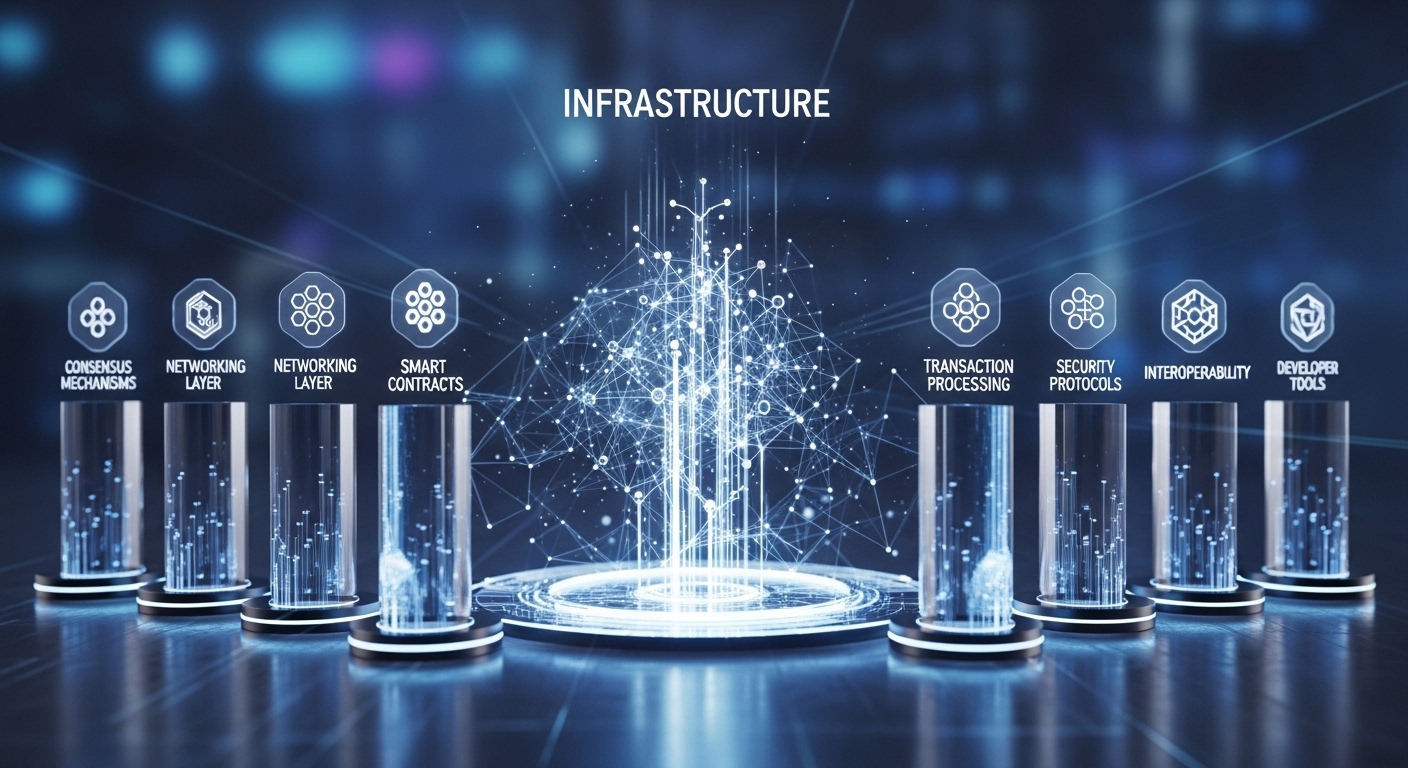
Web3 is often described as a new internet—open, composable, and owned by its users. But when people talk about Web3, the spotlight usually lands on flashy Layer 1 networks, meme coins, NFT drops, or the latest DeFi trend. What rarely gets the same attention is the quieter machinery underneath: the blockchain infrastructure protocols that make Web3 usable, scalable, and reliable in the real world.
If blockchains are cities, blockchain infrastructure protocols are the roads, power lines, maps, logistics hubs, and security systems that keep everything functioning. They route messages across networks, deliver off-chain data to on-chain smart contracts, help apps query historical blockchain information quickly, and reduce the burden on base layers by splitting execution from data. Without strong blockchain infrastructure protocols, the promise of Web3 becomes an endless series of slow transactions, broken cross-chain bridges, unreliable data feeds, and apps that can’t serve mainstream users.
The infrastructure layer matters even more now because Web3 is becoming modular. Instead of one chain doing everything—consensus, execution, data availability, settlement—different networks specialize. That specialization is powerful, but it also increases dependency on the connective tissue between systems. That connective tissue is, once again, blockchain infrastructure protocols.
In this article, you’ll learn about eight blockchain infrastructure protocols that quietly power Web3 across interoperability, cross-chain messaging, oracle networks, decentralized indexing, data availability, and shared security. These are not just technical curiosities. They are the systems that developers rely on to ship production-grade dApps, the rails that institutions evaluate for risk, and the invisible foundation that everyday users benefit from—often without realizing it.
Polkadot: Interoperability Built Into the Base Layer
Polkadot is one of the most recognized blockchain infrastructure protocols focused on interoperability, but it still tends to be discussed less than headline-grabbing smart contract chains. Its core idea is that Web3 won’t be one chain—it will be many specialized networks that need to communicate securely. Polkadot is designed as a Layer 0 relay chain that coordinates multiple parachains, enabling them to share security and exchange messages.
How Polkadot Powers Web3 Under the Hood
As blockchain infrastructure protocols go, Polkadot’s architecture is purpose-built for chain-to-chain collaboration. Instead of forcing every application into one execution environment, Polkadot lets parachains optimize for different use cases—DeFi, identity, gaming, enterprise—while maintaining a shared security model. This reduces duplication of validator sets and avoids the fragility of ad-hoc bridging.
Why Developers Care About Shared Security
In practice, shared security is one of the most underrated benefits of blockchain infrastructure protocols like Polkadot. Bootstrapping a secure network is hard. A new chain can have brilliant tech but weak security if it lacks a robust validator ecosystem. Polkadot’s model helps parachains inherit a stronger baseline, letting teams focus on product development instead of reinventing consensus economics.
The Interoperability Angle That Matters
Interoperability is often marketed as a buzzword, but it becomes real when apps depend on cross-chain composability. Polkadot’s ecosystem aims to make cross-chain interactions more native and less reliant on risky bridge designs. As Web3 grows more modular, blockchain infrastructure protocols that handle interoperability at the protocol level become increasingly valuable.
Cosmos: The Internet of Blockchains via IBC
Cosmos is another pillar among blockchain infrastructure protocols, often summarized as the “Internet of Blockchains.” Its major contribution is the Inter-Blockchain Communication protocol (IBC), a standard that allows independent chains—called zones—to transfer data and tokens in a structured way. Cosmos doesn’t force a single shared security framework by default; it focuses on enabling sovereign chains to coordinate through common standards.
IBC as a Standard, Not a One-Off Bridge
A major reason Cosmos stands out among blockchain infrastructure protocols is that IBC aims to be a repeatable, auditable, and standardized approach to cross-chain transfers. Bridges have historically been a major attack surface in Web3. Cosmos’ approach tries to reduce that chaos by treating cross-chain communication as a first-class design element rather than an afterthought.
Sovereignty and the Modular Thesis
Cosmos resonates with teams that want control over governance, validator selection, and chain-level customization. In a modular world, these choices matter. Many builders see sovereign app-chains as a path to better performance and tailored economics. But sovereignty also means you need dependable blockchain infrastructure protocols—especially for interoperability and liquidity routing—so you don’t end up isolated.
Where Cosmos Quietly Shows Up
Even if users don’t think about Cosmos directly, Cosmos-based chains and IBC routes underpin real activity across DeFi and staking ecosystems. This is what “quietly powering Web3” looks like: users swap, stake, and transfer while blockchain infrastructure protocols handle the complexity behind the scenes.
Chainlink: The Oracle Layer Smart Contracts Depend On
Smart contracts can’t access off-chain data on their own. That’s a fundamental limitation of blockchains: determinism and security come at the cost of external connectivity. Chainlink is one of the most important blockchain infrastructure protocols because it solves that limitation through decentralized oracle networks, bringing real-world information—prices, interest rates, weather data, proof of reserve, and more—on-chain.
Oracles Are Infrastructure, Not a Feature
Oracles are sometimes spoken about like a DeFi add-on, but they’re foundational. Without oracle-driven data, lending markets can’t price collateral, synthetic assets can’t track real markets, and many automated strategies can’t function. Chainlink, as a major player among blockchain infrastructure protocols, is deeply woven into DeFi’s risk engine.
Beyond Price Feeds: Verifiable Computation and Messaging
Chainlink has expanded beyond basic data feeds into broader infrastructure functions such as verifiable randomness and cross-chain communication primitives. This matters because it positions Chainlink as part of a wider “trust layer.” When Web3 applications need reliable external inputs, blockchain infrastructure protocols like Chainlink become the difference between a robust financial product and an exploitable toy.
Why Reliability Beats Hype
Infrastructure wins by being dependable, not by trending. Chainlink’s value is that it reduces systemic risk. In the long run, Web3 doesn’t scale on excitement—it scales on boring reliability. That’s exactly what the best blockchain infrastructure protocols deliver.
Decentralized Indexing for On-Chain Data
Blockchains are not designed for fast, complex queries. If you’ve ever tried to build an app that needs historical transaction data, user positions, NFT metadata lookups, or analytics dashboards, you quickly run into the limits of raw node queries. The Graph is a leading example of blockchain infrastructure protocols that solve this by providing decentralized indexing and queryable APIs for blockchain data.
Why Querying Blockchains Is Hard
Blockchains optimize for consensus and verification, not for application-level queries. Without indexing, a dApp might require heavy backend infrastructure or centralized databases to serve users. The Graph’s role among blockchain infrastructure protocols is to help developers retrieve structured data efficiently while keeping the data layer more open and censorship-resistant.
Subgraphs and Composability
The Graph popularized “subgraphs,” which define how to index specific smart contracts and expose that data via queries. The result is that teams can build faster and reuse existing data structures. This is Web3 composability in practice, and it depends on blockchain infrastructure protocols that reduce friction for builders.
Quiet Impact on User Experience
When a wallet shows you DeFi positions instantly or an NFT marketplace loads metadata quickly, users feel the benefit of indexing—even if they never hear the name. This is the invisible nature of blockchain infrastructure protocols: they show up as smooth UX, fewer outages, and faster product iteration.
Celestia: Data Availability for Modular Blockchains

As the modular blockchain thesis gains momentum, data availability becomes a central concern. If execution happens on rollups and settlement happens elsewhere, where does the transaction data live—and how do participants verify it’s available? Celestia is one of the most talked-about recent blockchain infrastructure protocols in this category, focused specifically on data availability.
Data Availability Is the Unsung Bottleneck
Scaling isn’t just about processing transactions quickly. It’s also about ensuring the underlying data is accessible so the network can be verified and disputes can be resolved. Celestia’s approach reframes blockchains as specialized layers. Instead of doing everything, it aims to provide a reliable data layer so rollups can focus on execution.
Why This Matters for Rollups
Rollups depend on published data to remain verifiable. If data is withheld, users can’t reconstruct the chain’s state. This is why blockchain infrastructure protocols centered on data availability are becoming a big deal. They’re not glamorous, but they’re essential for scalable, trust-minimized systems.
A More Flexible Web3 Stack
Celestia supports the idea that teams should be able to choose the best execution environment without inheriting unnecessary constraints. The bigger Web3 becomes, the more it will rely on blockchain infrastructure protocols that let developers mix and match components without sacrificing security assumptions.
EigenLayer: Restaking and Shared Security for New Services
EigenLayer introduced a concept that has reshaped conversations around security in Ethereum’s ecosystem: restaking. Rather than creating entirely new trust networks for every service, EigenLayer aims to let Ethereum stakers “re-use” security for additional protocols and services, often called actively validated services (AVSs). As blockchain infrastructure protocols go, EigenLayer is about making security more capital-efficient—while also raising new design questions.
The Shared Security Value Proposition
Many Web3 services need economic security: oracles, data layers, bridges, and middleware. Bootstrapping security is expensive and slow. EigenLayer’s pitch is that these services can borrow from Ethereum’s established staking base, accelerating time-to-trust. This is a powerful expansion of what blockchain infrastructure protocols can do: not just connect chains, but also distribute security.
Risks and Tradeoffs That Matter
Security reuse sounds great, but it introduces complexity. Slashing conditions, operator risk, correlated failures, and governance incentives all become more intricate when staked capital backs multiple systems. The reason EigenLayer still belongs on a list of critical blockchain infrastructure protocols is that it spotlights a real need: scalable security. But it also reminds the industry that infrastructure is where risk concentrates.
Why Web3 Keeps Coming Back to Security
As Web3 matures, trust assumptions become product features. Institutions and serious builders care deeply about attack surfaces. Protocols like EigenLayer show how blockchain infrastructure protocols increasingly compete on security design, not marketing.
LayerZero: Cross-Chain Messaging as a Core Primitive
Cross-chain experiences are moving beyond token bridges. Users want to interact with apps across ecosystems without manually juggling networks and assets. LayerZero is part of a newer class of blockchain infrastructure protocols that focus on generalized cross-chain messaging, enabling applications to send instructions and state updates between chains.
Messaging vs. Bridging
Traditional bridges focus on moving assets. Messaging protocols focus on moving information and intent. That difference matters because modern Web3 apps often need more than token transfers. They need cross-chain governance actions, account abstractions, or synchronized liquidity strategies. In that context, blockchain infrastructure protocols that provide messaging become critical building blocks.
What “Omnichain” Really Means
The omnichain idea is that a user should experience an app, not a network. Messaging infrastructure is how that becomes possible. Instead of creating isolated versions of the same dApp per chain, teams can orchestrate unified experiences. This doesn’t eliminate risk—cross-chain systems are complex—but it moves Web3 closer to mainstream usability, powered by blockchain infrastructure protocols.
Why Cross-Chain Infrastructure Must Mature
Cross-chain exploits have been some of the most damaging events in Web3. That’s why the evolution from improvised bridges to more deliberate blockchain infrastructure protocols matters. The end goal is a world where cross-chain interactions are routine, secure, and boring—in the best way.
Pocket Network: Decentralized RPC Infrastructure for dApps
Every time a wallet shows your balance or a dApp loads on-chain state, it is typically querying an RPC endpoint. RPC infrastructure is one of the most overlooked parts of Web3. Many apps rely on centralized providers, which can create outages, censorship risks, or single points of failure. Pocket Network is a notable example of blockchain infrastructure protocols that provide decentralized RPC access so applications can interact with multiple chains more reliably.
RPC Is the Front Door to Web3
If RPC services degrade, the user experience collapses. Transactions fail, balances don’t load, and apps appear “broken” even if the chain is fine. Pocket Network’s value among blockchain infrastructure protocols is that it treats RPC as a decentralized marketplace, aligning node operators and developers through incentives.
Why Decentralizing Access Matters
Decentralization is not only about consensus; it’s also about access. If a handful of providers control RPC gateways, they can become choke points. Infrastructure decentralization reduces that systemic fragility. As Web3 grows, blockchain infrastructure protocols that decentralize access layers become increasingly important for resilience.
Quiet Power Through Reliability
Users rarely praise an app because its RPC provider worked. They only notice when it fails. That’s why RPC infrastructure is one of the most “quietly powering Web3” categories. The best blockchain infrastructure protocols in this space win by being invisible.
Conclusion
The future of Web3 won’t be decided only by which Layer 1 is fastest or which app goes viral next. It will be shaped by the blockchain infrastructure protocols that make decentralized systems practical at scale. Interoperability frameworks like Polkadot and Cosmos help networks collaborate. Oracle layers like Chainlink feed real-world truth into smart contracts. Indexing systems like The Graph turn raw blockchain history into usable application data. Data availability networks like Celestia support modular scaling. Shared security models like EigenLayer push new possibilities—and new risks. Messaging protocols like LayerZero aim to make cross-chain experiences feel seamless. And decentralized RPC networks like Pocket keep the front door to Web3 open and resilient.
These blockchain infrastructure protocols don’t always trend on social media, but they’re where serious innovation concentrates. They reduce friction for developers, improve safety for users, and turn the abstract promise of decentralization into something that can actually serve millions. If you want to understand what’s really powering Web3, watch the infrastructure—because that’s where the quiet wins become the lasting ones.
FAQs
Q: What are blockchain infrastructure protocols in simple terms?
Blockchain infrastructure protocols are foundational networks and services that support blockchains and dApps, such as interoperability layers, oracle networks, indexing tools, data availability layers, and decentralized RPC providers.
Q: Why do blockchain infrastructure protocols matter for Web3 adoption?
Web3 adoption depends on reliability, speed, and usability. Blockchain infrastructure protocols improve user experience by enabling faster data queries, safer cross-chain interactions, accurate real-world data feeds, and more scalable network architectures.
Q: Are blockchain infrastructure protocols the same as Layer 1 blockchains?
Not necessarily. Some blockchain infrastructure protocols are Layer 0 or middleware, while others provide specialized services like decentralized indexing or data availability. They can support many chains rather than being the chain users transact on directly.
Q: What’s the biggest risk area in blockchain infrastructure today?
Cross-chain systems and bridge-like components have historically been high-risk because they expand the attack surface. As a result, many newer blockchain infrastructure protocols focus heavily on security design, verification models, and reducing trust assumptions.
Q: How can investors or builders evaluate blockchain infrastructure protocols?
Builders often evaluate blockchain infrastructure protocols by reliability, security assumptions, integration tooling, developer adoption, and ecosystem fit. Investors often look at usage, fee capture or token utility, sustainability of incentives, and whether the protocol is becoming a standard part of the Web3 stack.
